
The religion of the pharaohs has occupied historians’ and archaeologists’ minds for decades. They were not just legends or isolated priestly rituals; they were the nucleus from which the greatest civilizations of the ancient world emerged. Religious belief guided every detail of life on the banks of the Nile, from city planning and the construction of pyramids and temples to agriculture, criminal laws, and medical and astronomical sciences.
1. Were the Pharaohs pagans or monotheists?
The nature of ancient Egyptian religion raises a wide intellectual debate among researchers. The appearance of religion reflects a wide multiplicity of gods (Polytheism), but an in-depth examination of ancient religious texts such as the “Pyramid Texts” and the “Book of the Dead” reveals complex theological ideas and different interpretations of divine power.
The ancient Egyptians did not see a conflict in the multiplicity of gods, but rather they saw in every god a manifestation of a great universal divine force that governs existence. “Ra” is the manifestation of creative power through the disk of the sun, “Thoth” is the manifestation of wisdom and knowledge, “Osiris” is the manifestation of resurrection and immortality, and “Ptah” is the manifestation of creativity and material formation. These gods served as symbolic media for understanding the universe and unraveling its invisible secrets.
2. What are the most famous gods of ancient Egypt and their symbols?
The Egyptian pantheon of gods varied throughout the ages, and their importance varied according to the political capital and historical stage:
- Amun Ra (King of the Gods): “Amun” (the hidden power and pillar of the Theban faith) was merged with “Ra” (the god of the sun and the light of existence) to become the greatest national and cosmic god in the era of the New Kingdom, combining the inner and the outer.
- Osiris (Lord of the Underworld and Resurrection): Hero of the most famous myth in ancient history; the god who was treacherously killed by his brother “Set” (a symbol of chaos and evil), who returned to life under the care of his loyal wife “Isis” to become the judge of the dead and a symbol of fertility and renewal of life.
- Isis (symbol of motherhood, loyalty, and magic): The protector goddess whose fame transcended the borders of Egypt and reached Greece and the Roman Empire, and represented love, sacrifice, and the ability to revive what was destroyed.
- Horus (falcon god and protector of kingship): Son of Osiris and Isis, and defender of his father’s throne in his battle against the forces of darkness; the ruling pharaoh was seen as the living embodiment of Horus on Earth.
- Anubis (protector of the cemetery and patron of mummification): The god embodied with the head of a jackal, who oversees the rituals of mummification of bodies and preserves them from destruction, and the spiritual companion of the deceased on his journey towards trial.
- Thoth (Lord of Wisdom and Divine Scribe): The owner of the head of an ibis, the inventor of hieroglyphics, the supervisor of the scales of justice, and the recorder of the results of hearts in the courtroom.

3. Why did pharaohs sanctify the animals?
One of the most common misconceptions is the belief that the ancient Egyptians worshiped animals for their physical sake. In fact, religious thought took the animal as a metaphorical symbol or “earthly vessel” that carries an aspect of the attribute of God:
- Falcon: It flew high and was characterized by sharp eyesight and a quick pounce, so Horus took it as a symbol of sublimity and sovereignty.
- Jackal: Jackals were associated with guarding the edges of the desert and cemeteries, so they symbolized Anubis to protect and purify graves.
- The lioness: She reflected offensive power and invincible brutality, and was embodied in Sekhmet, the goddess of war and healing.
- Apis Bull: It was selected with specific and rare physical characteristics to become the “living physical embodiment” of the energy of the god Ptah in Memphis, and was treated throughout its life with exceptional reverence and then mummified in the huge Serapeum tombs at Saqqara.
4. The concept of “Maat”: the cornerstone of cosmic and moral stability
Egyptian religion was not isolated from human conscience and social justice. The concept of “Maat” represented the essential foundation of existence. “Maat” symbolizes truth, honesty, balance, and the perfect natural order in the face of “Isfet” (chaos, corruption, and injustice).
The pharaoh’s first mission before the gods was to establish “Maat” on earth and fight the forces of chaos. Approaching the gods was not accepted through sacrifices alone, but rather on the condition of the individual’s commitment to moral rectitude, protecting the poor and the oppressed, not polluting the course of the Nile, and preserving the environmental and social balance.
5. Temple rituals and the homes of priests
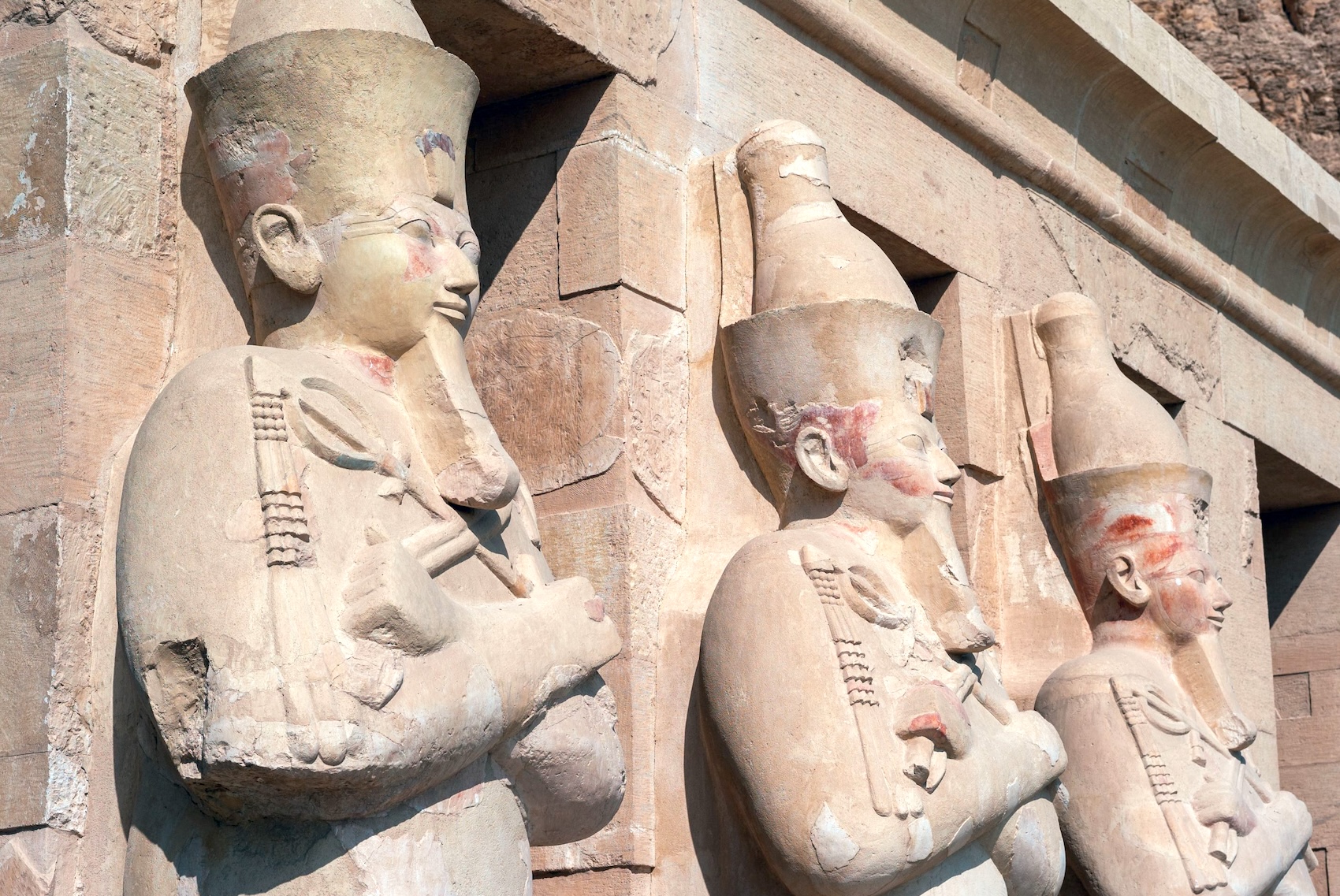
The ancient Egyptian temple was called “Bar-Nether,” meaning (the House of God), and it was not built to be a place for public prayers, but rather an accurate architectural simulation of the moment of the creation of the universe from eternal water:
- Holy of Holies: The deepest and darkest room in the temple, and it includes the wooden chamber (naos) that houses the statue of the god inlaid with gold and precious stones.
- Daily divine service: The high priest, on behalf of the king, would enter at dawn after washing and purifying himself, open the sarcophagus, recite hymns, wash the statue, anoint it with aromatic oils, cover it with the finest linen fabrics, and then serve the daily sacrificial meals.
- Popular celebrations: Because the public was denied entry to the Holy of Holies, major religious holidays (such as the Feast of Opet and the Feast of the Beautiful Valley) were the only opportunity for direct communication with the gods, as the statue of the god was carried inside his sacred boat on the shoulders of the priests in solemn processions that circumnavigated the Nile and the corridors of the temples.
6. The journey of immortality and the court of the dead in the other world
The ancient Egyptians believed that death was not the end, but merely a gateway to eternal life. This journey required precise preparations to preserve the complex human being:
Elements of the human psyche:
- Khat: The earthly physical body; therefore, the pharaohs developed the science of mummification with great precision to protect him from decomposition, so that his soul would recognize him upon return.
- Ka: The companion and vital energy that continues after death and requires food, drink, and offerings in the cemetery.
- Ba: The personal spirit depicted in the form of a bird with a human head who has the freedom to leave the cemetery during the day and return at night.
- Ren: The name of the deceased; as long as it was read and engraved on the walls, the deceased was believed to remain alive in eternity.
Trial of the Dead (Hall of Two Truths):
The deceased stands before Osiris and 42 judges to recite the “negative confession,” absolving himself of sins and violations of the rights of others. After that, the precise calculation process is performed:
The heart of the deceased (the repository of conscience and deeds) is placed on the scales of justice.
The “Maat” feather is placed on the opposite side.
The heart was heavy with its sins, and its fate was to be thrown to the legendary monster “Ammut” to devour it, so that the deceased would die the “second death,” which is nothingness and absolute annihilation.
If the heart is equal to the feather of truth, the deceased is declared “Maa-kheru” (honest in words and deeds), and Horus leads him to enter the “Fields of Reeds (Aaru)”; this was the eternal paradise of the pharaohs, where there is prosperity, abundance, and an uninterrupted blissful life.

Mokhtar Yonis
A professional tour guide since 2008, I have led thousands of tours all over Egypt. As an Egyptologist with a Master's degree in Egyptology from Cairo University, I bring a deep knowledge of and passion for Islamic history, monuments, and modern Egyptian culture. A Cairene for most of my life, I joined NileCruisen company in 2016 as a professional tour guide and travel editor.
- Mokhtar Yonis
- Mokhtar Yonis
- Mokhtar Yonis
- Mokhtar Yonis