 Mokhtar Yonis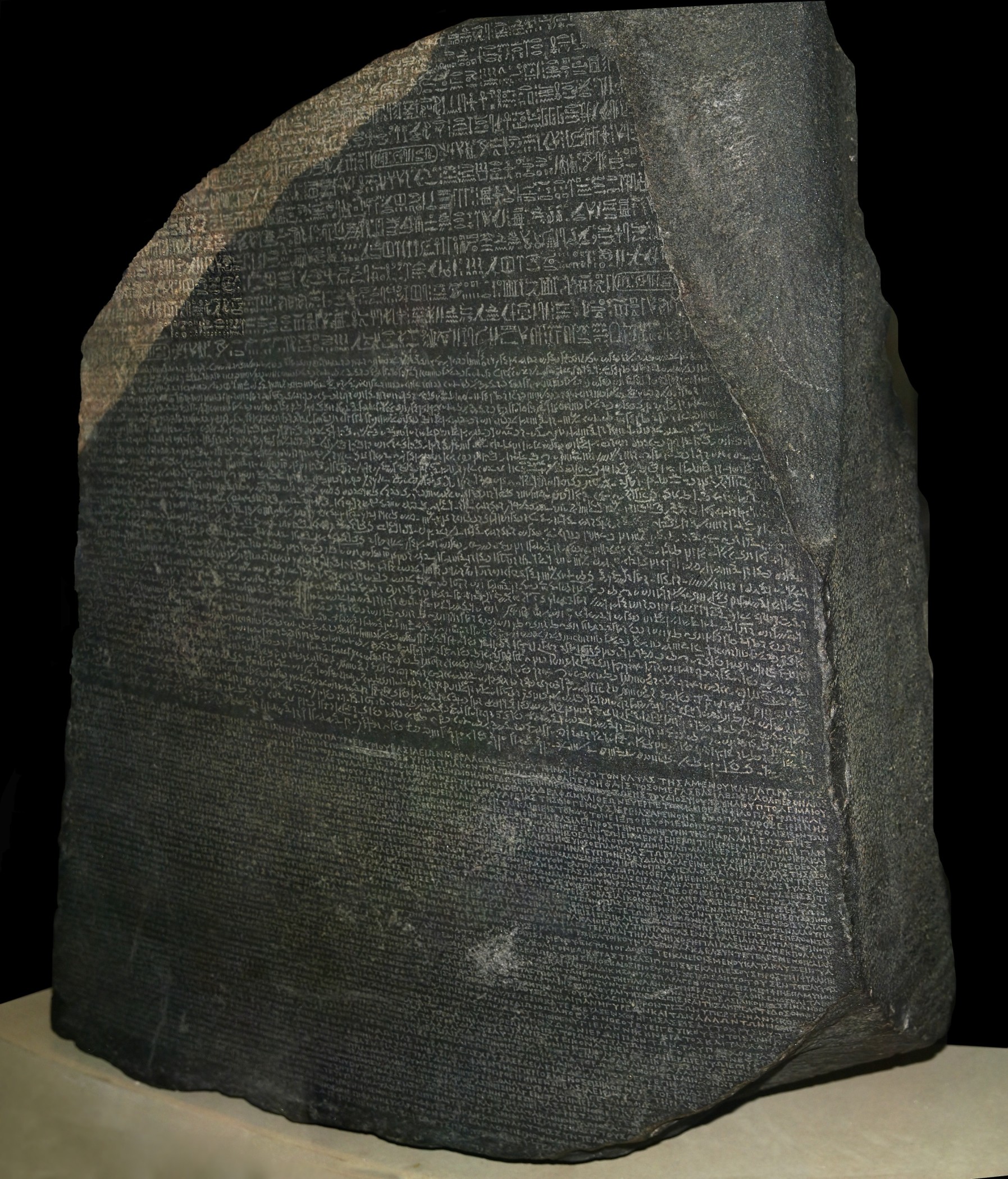
The Rosetta Stone is considered important because it helped experts understand the language of ancient Egypt. Many people often think, “What is the Rosetta Stone?” The Rosetta Stone is a large stone that contains the same message written in three different scripts: Egyptian hieroglyphs, demotic, and ancient Greek. This stone helped scholars to learn to read Egyptian hieroglyphs.
Table of Contents:
-
Rosetta Stone at a Glance
-
Why Is It So-Called?
-
Where Was the Rosetta Stone Found?
-
Who Created the Rosetta Stone?
-
What Is the Rosetta Stone Made Of?
-
What Is the Actual Message in the Rosetta Stone?
-
Why Is the Rosetta Stone Important?
-
Why Were The Three Scripts Used On The Rosetta Stone?
-
What Does the Rosetta Stone Look Like?
-
Why Is the Rosetta Stone Controversial?
-
Who Deciphered the Rosetta Stone?
-
What Did Historians Learn From It?
-
How Were Egyptian Hieroglyphs Decoded?
-
Interesting Facts Regarding The Rosetta Stone
-
Why Is It Important For Egyptology?
-
Timeline Of The Rosetta Stone
-
Explore Ancient Egypt Beyond the Rosetta Stone.
-
FAQs
-
Conclusion
Rosetta Stone at a Glance
| Feature | Details |
| Name | Rosetta Stone |
| Discovered | 1799 |
| Found near | Rosetta (now called Rashid), Egypt |
| Created | 196 BC |
| Material | Granodiorite |
| Height | 112.3 cm |
| Width | 75.7 cm |
| Weight | Approximately 760 kg |
| Script | Egyptian Hieroglyphs, Demotic, and Ancient Greek |
| Current location | British Museum, London |
Why Is It So Called?
It is believed that the Rosetta Stone got its name from a city named Rashid, where it was discovered. During Napoleon Bonaparte’s campaign in 1799 in Egypt, a French soldier named Pierre François Bouchard found this stone.
Where Was the Rosetta Stone Found?
The stone was found near the town named Rosetta in Northern Egypt. During Napoleon Bonaparte’s military campaign, a French soldier named Pierre François Bouchard discovered the Rosetta Stone. However, after the French defeat in Egypt, the stone was transferred to British control in London in 1801. It was later transported to London and has been displayed at the British Museum since 1802.
Who Created the Rosetta Stone?
The Rosetta Stone contains a decree that was issued by a council of Egyptian priests in 196 BC; it was created to celebrate the king’s achievements and show support for his rule.
The priests created the decree because they wanted to recognize King Ptolemy V’s contributions. To make sure that the message could be understood by different groups, it was written in three scripts: Egyptian hieroglyphs, demotic, and ancient Greek.
What Is The Rosetta Stone Made Of?
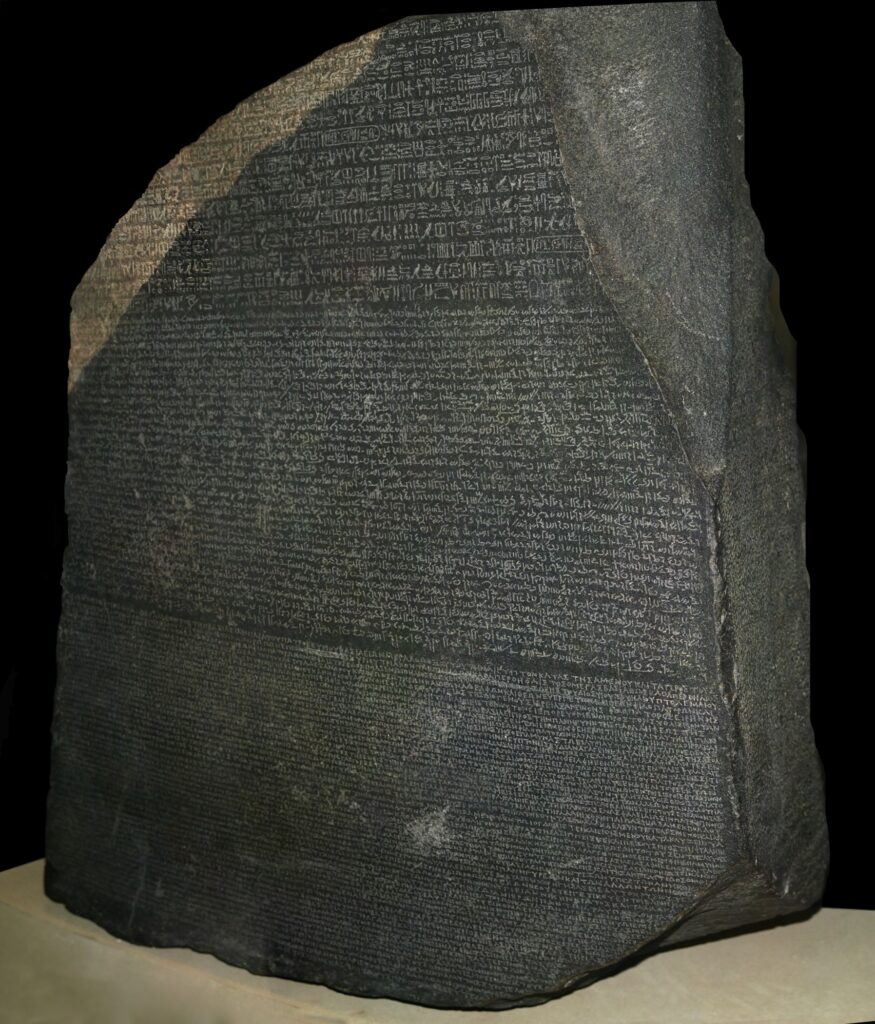
The Rosetta Stone is made up of a hard, dark-colored rock, granodiorite. It is about 112.3 cm tall and 75.7 cm wide, and it weighs around 760 kg. Its strong material helps to preserve it for over two thousand years.
What Is The Actual Message In The Rosetta Stone?
The Rosetta Stone contains an official message from ancient Egypt that praises King Ptolemy V.
The messages written on the stone talk about the king’s good work for the people, lower taxes, religious ceremonies, respect shown to the king, and orders to create copies of the message in temples across Egypt.
Why Is the Rosetta Stone Important?
The Rosetta Stone is considered important because before the discovery of this stone, scholars were not able to decode the text that was written on the walls of ancient temples and walls in Egypt. But in 1822, with the help of French scholar Jean-François Champollion, building on the earlier work of Thomas Young, the Egyptian hieroglyphs were deciphered, and historians were able to understand what was written on the temple walls, tomb inscriptions, and ancient temples.
Why Were the Three Scripts Used on the Rosetta Stone?
The message written on the Rosetta Stone has three different scripts, and the major reason behind it is that it contains a single decree written for three different groups.
Hieroglyphic Script: It is used for sacred and formal texts by priests.
Demotic Script: It is used for daily native Egyptian writing and business.
Ancient Greek: It is used by the ruling government of Egypt.
What Does the Rosetta Stone Look Like?
The Rosetta Stone is an irregularly shaped stone that is made up of granodiorite. Its surface contains three writings: Egyptian hieroglyphs at the top, demotic in the middle, and ancient Greek at the bottom. However, some parts of the stone are missing, but the remaining text has helped many scholars understand the meaning of the Egyptian writings.
Why Is the Rosetta Stone Controversial?
The Rosetta Stone is still discussed today because of the place where it is kept. After the French lost control of Egypt, the stone was taken to Britain in 1801. Today it is displayed in the British Museum in London.
It is controversial because of an ongoing debate regarding its ownership; many Egyptian archaeologists and officials believe that it should be returned to Egypt, as they consider it an important part of ancient history.
Who Deciphered the Rosetta Stone?
The decipherment of Egyptian hieroglyphs was a gradual process, with Thomas Young making important early discoveries and Jean-François Champollion making the major breakthrough in 1822. He also discovered that hieroglyphs represented both sounds and ideas. His work helped historians read ancient Egyptian inscriptions that they were not able to understand before.
What Did Historians Learn From It?
The discovery of the Rosetta Stone helped many historians to read the inscriptions that are written on various ancient monuments, such as temples, tombs, statues, etc. Before the discovery of the Rosetta Stone, much of this writing remained a mystery. However, after scholars learned to understand them, it helped them to read valuable information regarding the lives of pharaohs, religious beliefs, laws, and everyday activities. With the help of the Rosetta Stone, historians were able to learn about various ancient monuments and the following:
- Egyptian kings and rulers
- Religion and belief
- Daily life
- Law and government
- Trade and economy
- Historical events
Note: The Rosetta Stone did not directly contain all this information; it just provides the key that allows historians to read thousands of other ancient Egyptian texts and discover the history.
How Were Egyptian Hieroglyphs Decoded?
Before the discovery of the Rosetta Stone, scholars were not able to understand the Egyptian hieroglyphs. Later, Jean-François Champollion studied the names of rulers written in curved oval shapes, and he also discovered that hieroglyphs represent sounds as well.
Interesting Facts Regarding The Rosetta Stone
- The Rosetta Stone is over 2200 years old.
- It was discovered in 1799
- It weighs about 760 kg.
- It is made of granodiorite (a very hard rock).
- It contains the same message in the three scripts.
- It is one of the most visited objects in the British Museum.
- It helped scholars to understand the meaning of ancient Egyptian hieroglyphs.
Why Is It Important For Egyptology?
Many individuals often think about why Rosetta Stone is considered important for Egyptology, and the answer is simple: it is considered crucial because it allows scholars to study ancient history, culture, language, and civilization. Its decoding allows many historians to decode the thousands of ancient texts that reveal information about Egyptian rulers, religion, everyday life, etc. It is believed that the Rosetta Stone has opened a new way that makes it easy to understand one of the world’s most polished civilizations. This stone contributed a lot to the development of Egyptology.
Timeline Of The Rosetta Stone
The timeline below will provide you with brief information regarding the Rosetta Stone.
196 BC: The stone was created during the reign of Ptolemy V.
1799: It was discovered by a French officer named Pierre François Bouchard.
1801: Taken by Britain after the French defeat.
1802: Displayed at the British Museum
1822: Jean-François Champollion successfully deciphered hieroglyphs.
Explore Ancient Egypt Beyond the Rosetta Stone On a Nile Cruise
The discovery of the Rosetta Stone helps to unlock ancient Egyptian history, as it allows historians to understand the stories that are carved on the walls of the temples, tombs, and monuments across Egypt. Even tourists can visit these places and see the inscriptions that reveal the lives, beliefs, and achievements of ancient Egyptians.
A Nile cruise offers the perfect opportunity to visit historic landmarks, including Philae Temple, Kom Ombo Temple, Edfu Temple, Karnak Temple, and the Valley of the Kings. Guided excursions to these monuments allow travelers to learn more about the civilization whose inscriptions helped reveal the story of ancient Egypt.
Just like other travelers, if you also want to explore these historic sites, then you can consider Nile Cruisen, as it offers an amazing journey between Aswan and Luxor by combining comfortable travel with opportunities to discover some of Egypt’s most important ancient monuments. While traveling with us, travelers can experience the temples, inscriptions, and other archaeological treasures that bring the history discussed in this article to life.
FAQs
Why is the Rosetta Stone famous?
The Rosetta Stone is famous because its decoding helped many historians unlock the meaning of Egyptian hieroglyphs.
What does the Rosetta Stone say?
The Rosetta Stone contains a decree that praises King Ptolemy V. It describes his achievements, support for the temple, and religious honors.
Where is the Rosetta Stone today?
Today the Rosetta Stone is displayed at the British Museum in London, England.
Who discovered the Rosetta Stone?
The Rosetta Stone was discovered by a French army officer named Pierre François Bouchard. He discovered the stone during Napoleon Bonaparte’s military campaign in 1799.
Who cracked the code on the Rosetta Stone?
A French scholar named Jean-François Champollion deciphered the Rosetta Stone in 1822, building on the earlier work of Thomas Young.
Can I see the Rosetta Stone on a Nile cruise?
No, you can’t see the Rosetta Stone on a Nile cruise because it is displayed at the British Museum in London. However, while sailing with a Nile cruise, you will get an opportunity to explore the ancient sites and temples that contain inscriptions that became easier for historians to understand after the decipherment of Egyptian hieroglyphs.
Conclusion
Many people often compare it to a rock, but this is much more than that. Egyptians considered it one of the greatest discoveries, as it helped many historians to understand the writing system that had remained undeciphered for centuries. With the help of the Rosetta Stone, historians are able to read the inscriptions that are written on tombs, temples, and monuments, which provide valuable information about Egyptian kings, religion, and everyday life.
If you want to explore the places where these inscriptions still exist, then a journey with the cruise is perfect. While sailing between Luxor and Aswan, you will get an opportunity to explore the famous sites that tell the stories of the history of ancient Egypt, such as Karnak Temple, Edfu Temple, Kom Ombo Temple, the Valley of the Kings, and many more.

Mokhtar Yonis
A professional tour guide since 2008, I have led thousands of tours all over Egypt. As an Egyptologist with a Master's degree in Egyptology from Cairo University, I bring a deep knowledge of and passion for Islamic history, monuments, and modern Egyptian culture. A Cairene for most of my life, I joined NileCruisen company in 2016 as a professional tour guide and travel editor.
- Mokhtar Yonis

- Mokhtar Yonis
- Mokhtar Yonis
- Mokhtar Yonis