Egypt is a country where you will see some of the world’s most remarkable ancient places, and Pompey’s Pillar in Alexandria is one of the top attractions from its Roman past. Pompey’s Pillar has witnessed centuries of Egyptian history.
You might be interested in learning about an interesting story associated with Pompey’s Pillar, which is related to the Roman general Pompey. Before you visit Alexandria to explore Pompey’s Pillar, you must understand its history, architectural importance and location.
What Is Pompey’s Pillar in Egypt?
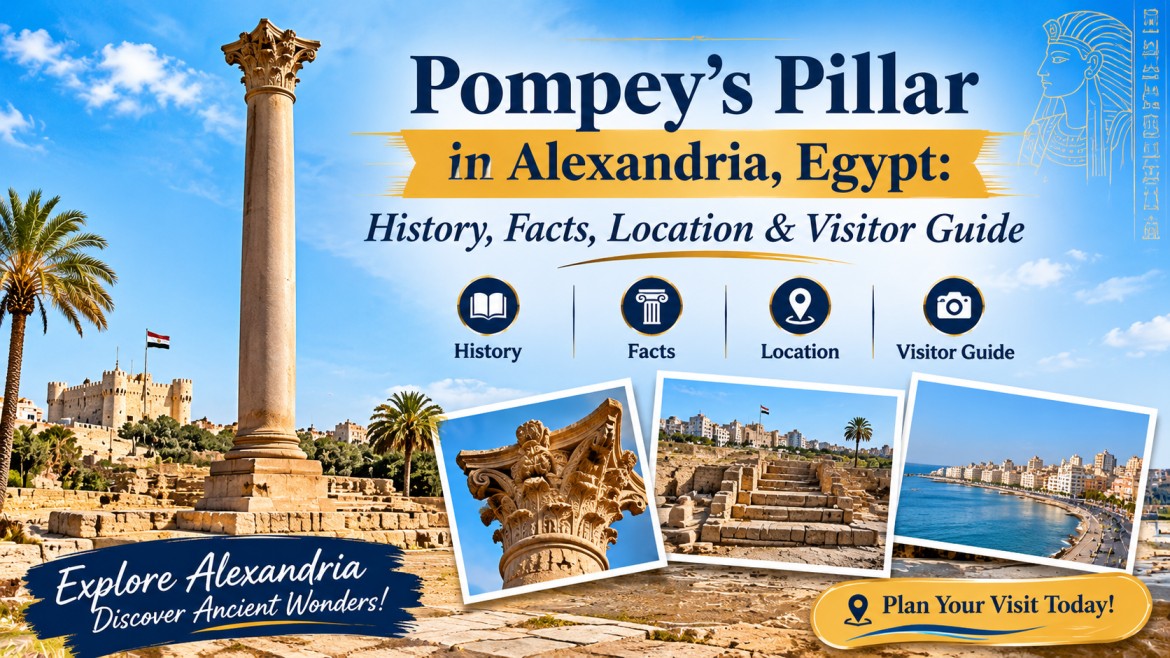
Alexandria is the place where Pompey’s Pillar is situated, which is a monumental Roman column. It is called Amud al-Sawari in Arabic and is located within the archaeological area of the ancient Serapeum, once an important religious centre built to honor the god Serapis.
Roman Emperor Diocletian was the main reason behind the establishment of this monument, and it was built around the late third century AD, dated to around 298-303 AD. The construction was remarkable because an enormous piece of red Aswan granite was used.
The height of the column, including its base, is around 26.85 metres. Due to its scale, it has become one of the most distinctive surviving Roman monuments in Alexandria.
Why Is It Called Pompey’s Pillar?
Now, you might have the question that is most often asked: Why is it known as Pompey’s Pillar? Despite its name, Pompey’s Pillar is not related to the famous Roman general Pompey the Great. The monument was actually built around AD 298–303 in honour of Roman Emperor Diocletian. An inscription on its base mentions a Roman official named Publius, who dedicated the column to the emperor. After some time, the name Publius was mistakenly linked to Pompey, and that’s how the pillar became known as Pompey’s Pillar.
Who Built Pompey’s Pillar and Why?
During the reign of Emperor Diocletian, Pompey’s Pillar was built. Emperor Diocletian ruled the Roman Empire from 284 to 305 AD. During his reign in Egypt, he stopped a rebellion and took control of Alexandria. Pompey’s Pillar was constructed to honour him and celebrate his victory. A large statue of the emperor once stood on top of it, but it no longer exists. An inscription on the base of the pillar shows that it was built in his honour.
Architectural Features of Pompey’s Pillar
The reason why the pillar has so much popularity is due to its elegant Roman design and enormous proportions. Read out the following interesting features about the pillar:
- Material: Red granite was used to make it, which was brought from the Aswan region of southern Egypt.
- Height: The height of the pillar, including its base, is around 26.85 metres.
- Column shaft: A massive piece of granite was used to make the column shaft.
- Capital: A decorative Corinthian-style capital at the top.
- Pedestal: A substantial granite base carrying the Greek dedication inscription.
Is There a Connection Between Pompey’s Pillar and the Serapeum?
Pompey’s Pillar is located on the site of an ancient Egyptian temple. This temple was known as the Serapeum and was constructed to be dedicated to a god known as Serapis. At that time, this place was worshipped by people. Today the temple is in ruins, but travelers can still see old stone structures, statues of sphinxes and underground passages around the pillar.
What is there to see at Pompey’s Pillar?
It’s more than a towering granite column. Here are some of the sights you can see at Pompey’s Pillar that we have listed:
- The Granite Column: You will see the impressive height, carving and architectural details of the monument.
- The Ancient Pedestal: Learn about the Greek dedication inscription to the Emperor Diocletianus.
- The Granite Sphinxes: Discover the ancient sphinx sculptures preserved within the archeological complex.
- Serapeum Remains: Explore the surviving structures and archeological features of the ancient sanctuary.
- Underground Galleries: You will also see the remains of the underground galleries and consider their possible religious and funerary significance.
If you love photography, you will be amazed by the contrast between the reddish granite monument and the surrounding archaeological landscape.
Where Is Pompey’s Pillar Located?
It is in the Karmouz area of Alexandria in northern Egypt, where Pompey’s Pillar is situated. It stands on the ancient hill of Bab Sidra, close to the archaeological area of Kom el-Shoqafa. You can reach this place by taking a taxi or private vehicle from central Alexandria. Additionally, you will also be able to explore other historical places around the city.
Best Time to Visit Pompey’s Pillar
If you are planning to visit Pompey’s Pillar, you might be wondering: When is the right time to visit Pompey’s Pillar? Generally, Alexandria has a Mediterranean climate, with mild winters and hot summers. If you want to explore the city’s outdoor archaeological sites, you can visit in spring and autumn. For sightseeing, December through February can also be pleasant, but it is crucial for travelers to be prepared for cooler temperatures.
Frequently Asked Questions About Pompey’s Pillar
-
Is Pompey’s Pillar in Alexandria or Cairo?
Pompey’s Pillar is located in Alexandria, Egypt.
-
How old is Pompey’s Pillar?
Its establishment was done between around 298 and 303 AD in the late this century AD.
-
Is Pompey’s Pillar connected to Pompey the Great?
No. The construction of this monument was done to dedicate it to Emperor Diocletian. Later, it was linked to Pompey because of historical misunderstanding.
-
What is Pompey’s Pillar made of?
Red Aswan granite was used to make Pompey’s Pillar. The main column shaft was carved using a single piece of stone.
-
How tall is Pompey’s Pillar?
Pompey’s Pillar is around 26.85 metres tall.
-
Is there an entrance fee for Pompey’s Pillar?
Yes. An entrance fee may be applicable, but the cost may vary.
-
Can Pompey’s Pillar be included in an Egypt holiday itinerary?
Yes. You can ask your tour operator if they can combine it with other Alexandria attractions that also cover Cairo, Luxor, and Aswan. If you are looking to specifically visit ancient places between Luxor and Aswan while cruising on the Nile, you can contact Nile Cruisen to book an Egypt river cruise.
Final Thoughts
Egypt is packed with full of ancient places, from Roman monuments in the North to ancient temples of Luxor and Aswan, every destination offers a different perspective on the country’s past. If you are planning an Egyptian-style holiday with a relaxing journey along the Nile, you can get in touch with Nile Cruisen.

This article was created by the team at Nile Cruisen, one of the best tour operators in Egypt for Nile cruises and tailor-made Egypt tours.
With years of experience sailing between Luxor and Aswan, our team knows the Nile better than anyone.
We share trusted travel advice, from the best time to visit and what to pack to simple tips for avoiding crowds.
Our goal is to help you enjoy the timeless beauty of Egypt with comfort, confidence, and an unforgettable travel experience.
- Nile Cruisen Team

- Nile Cruisen Team

- Nile Cruisen Team

- Nile Cruisen Team