 Nile Cruisen Team
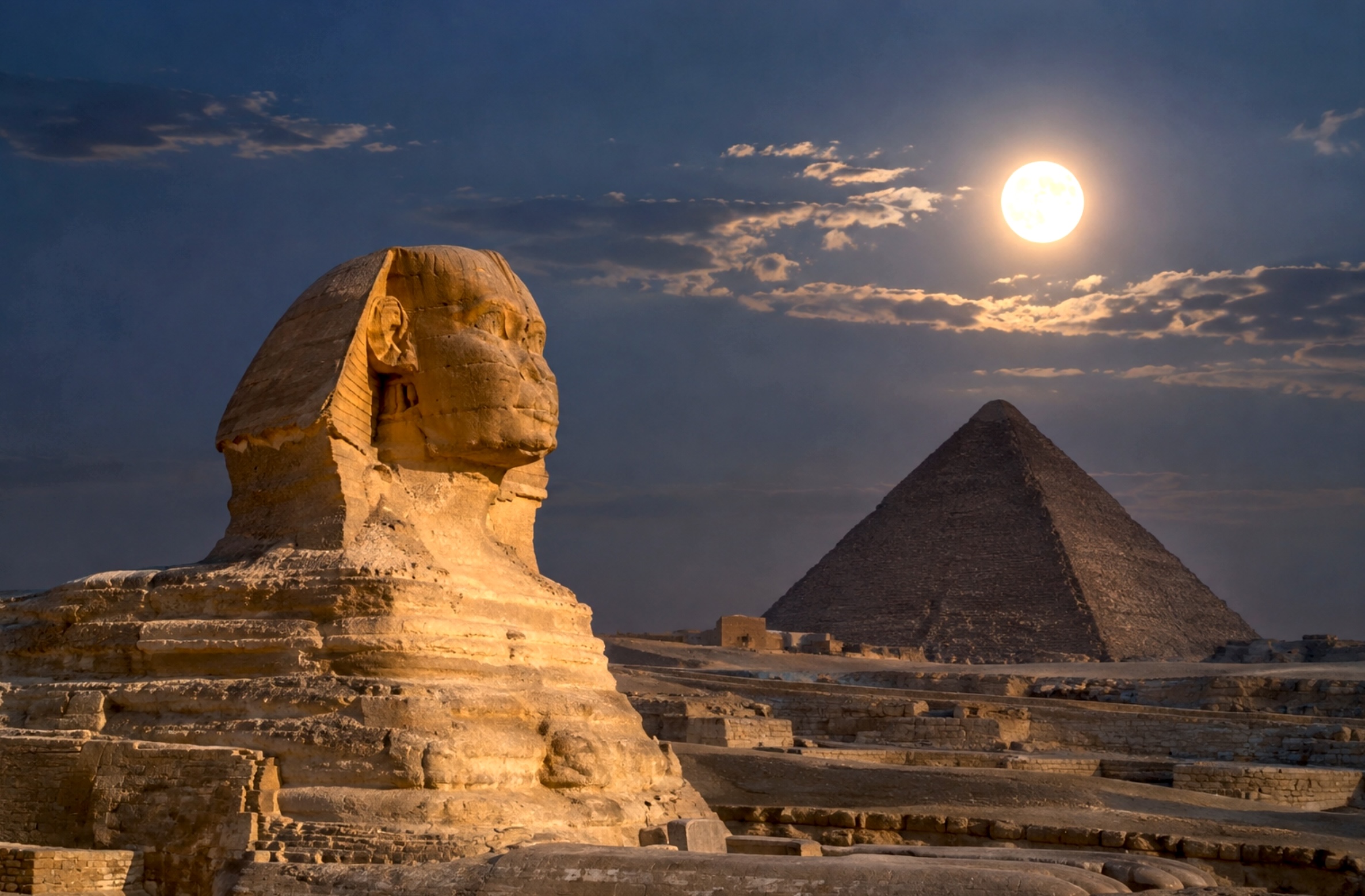
A historical and astronomical study on the brilliance of the ancient Egyptians and the myth of space.
Introduction: The magic of mystery and ancestors’ genius.
Since the decipherment of the Rosetta Stone and the discovery of the ancient Egyptian civilization, the world hasn’t stopped being amazed by the scale of achievements the pharaohs have accomplished. The amazing engineering accuracy in building the Pyramids, the deep knowledge of anatomy and medicine, and complex astronomical sciences made some people believe that this knowledge exceeded human capabilities in that era.
From here, one of the most famous science fiction and “ancient aliens” theories appeared:
Did the pharaohs have flight technology that enabled them to leave the atmosphere and reach the Moon?
No, pharaohs did not reach the Moon. Egyptology and archaeological evidence provide a definitive answer, and didn’t possess spacecraft. However, what they achieved on the earth was true scientific miracle that exceed imagination.
Chapter One: The roots of the myths and the alleged clues.
Proponents of the theory of ancient Egyptian space travel relied on a group of archaeological explorers whose findings were interpreted outside their historical and scientific context. The most prominent “pieces of evidence”:
- Abydos Helicopter (Inscriptions of the Seti I temple)
At one of the thresholds of the Seti I temple in Abydos, hieroglyphic inscriptions appear to look like a plane (Helicopter), a tank, a submarine, and a glider.
The scientific explanation: this phenomenon, known in archaeology as a “palimpsest,” reuses the inscription surface. The titles of King “Seti I” were carved. Later, in his son’s reign, “Ramses II,” all the old inscriptions were covered by a layer of plaster, and the titles of Ramses II were carved. Over thousands years, some parts of the plaster fell off, as a result, the father inscriptions overlap with the son inscriptions, which creates a visual coincidence that like modern machinery. - Saqqara bird
Discovered in the Saqqara tomb is a small wooden model of a bird made of sycamore wood, back to 200 BC. Some amateur engineers say that the wing angle and tail design make it a small model for an advanced glider or flying machine.
The scientific explanation:* the piece lacks some essential elements for actual flight, like a vertical steering tail. The archaeologists recommend it is either a children’s toy or a model of a bird that was placed on the top of the boat to determine the wind direction in the Nile, or a religious symbol associated with the god Horus (the falcon). - Orion correlation theory
Linking the three Pyramids in Giza and the three stars in Orion’s belt sparked speculation that the pharaohs received a space construction plane.
The scientific explanation: Egyptians actually passionately observed the sky and linked their Pyramids and temples to the stars for doctrinal and religious reasons (to guarantee the king’s soul to heaven), and not as a clue of actual travel.
Chapter Two: The true astronomical miracle of the Pharaohs
If they did not travel to space by their bodies, therefore they traveled by their minds. The ancient Egyptians were the first and greatest astronomers in history.
- Observatory “Nabta Playa”: over thousands of years before building Stonehenge in England, in the western desert the Egyptians built the oldest stone astronomical observatory in the world to follow the sun and moon movements and determine the rainy seasons.
- The accurate solar calendar: they were the first to divide the year into 364 days and 12 months. Relied on the heliacal rising of the star “Sirius”, which was closely associated with the beginning of the Nile flood.
- Star clocks (Decans): the pharaohs divided the night sky into 36 constellations and used them as (Stellar clocks to know time at night. This system is the basis that made us divide the day into 24 hours.
- Amazing astronomical engineering: orienting the Great Pyramid towards the actual magnetic north with zero error. Twice a year, the sun stands perpendicular on Ramses II’s face in the holy Holies at Abu Simbel Temple, and its alignments on the winter solstice day at the Karnak temple, all the proofs of their complete mastery of mathematics and observational astronomy.
Chapter Three: The travel into stars..a spiritual, not a physical, journey
The Pharaoh’s goal was not to explore space by modern technological means, but by the doctrinal sense. In the Pyramid Text (the oldest religious text in history), dedicated to the dead king, the goal is ascending to the sky and joining what they called the Imperishable stars. They meant stars (which never disappear from the horizon throughout the year, like the Thuban star that was the north star at that period). Travel to the sky for pharaohs was done through spiritual solar boats (such as Khufu’s boat) to give the king an eternal life between gods, not via metal rockets.
Conclusion:
The magic of Egyptian civilization does not need alien theories to be great. The ability to lift millions of tons of stone, observe the stars with the naked eye to create calendars, and build a civilization that lasts for thousands of years using tools of copper and stone is the true miracle that exceeds any imagination.