Introduction
Egypt is a place where you will see the world’s most remarkable ancient monuments, and Abydos is one of its most significant destinations. Abydos is situated in Upper Egypt, known as an ancient religious city that is famous for royal burial grounds, temples, and its connection with Osiris. Osiris is an Egyptian god linked to resurrection. The destination is especially known for the magnificent Temple of Seti I, which has preserved reliefs and the famous Abydos King List. Abydos is different from other attractions in Luxor, as it allows travelers to explore a crucial part of ancient Egyptian history differently. Whether you are looking to explore ancient mythology, archaeology, or Egypt beyond its famous tourist attractions, you should definitely visit Abydos. In this blog, you will come to learn about the history of Abydos, its top attractions, the best time to visit, and how to reach it from Luxor.
Where is Abydos in Egypt?
Abydos is situated in Sohag Governorate in Upper Egypt, near the town of El-Balyana. It sits around 160-175 kilometres north of Luxor by road; it may vary depending on the route you choose. In ancient times, Abydos was known as Abedju. It’s believed that its link was with the worship of Osiris, whose cult attracted pilgrims across the country.
When it comes to the archaeological area, you will have a great chance to explore the Temple of Seti I, the Temple of Ramesses II, the Osireion, and the ancient royal necropolis of Umm el-Qa’ab. If you are someone interested in understanding the religious traditions and early history of ancient Egypt, you should definitely visit Abydos.
History of Abydos
You might want to explore the history of Abydos, which stretches back to the earliest periods of Egyptian civilization.
Early Dynastic Period: During the First and Second Dynasties, Abydos became an essential royal burial centre because many early Egyptian kings were buried in the Umm el-Qa’ab necropolis. Due to these discoveries, you can have a better understanding of the growth of ancient Egyptian kingship.
Middle Kingdom: At that time, people started worshiping Osiris, and Abydos turned into a major pilgrimage destination. According to ancient Egyptians, the god’s burial place was in this region. Many people visited this place to attend religious ceremonies and honour Osiris.
New Kingdom: During the 19th Dynasty, Abydos achieved another milestone when Pharaoh Seti I built his temple. After him, his son Ramesses II built another temple in the area, continuing the work.
Later periods: The importance of Abydos continued for centuries. From its monuments and archaeological remains, it can be seen that development of Egyptian religious beliefs, funerary practices, and royal traditions.
3. Top Things to See in Abydos
1. Temple of Seti I
One of the top attractions that you can see in Abydos is the Temple of Seti I, which is considered the best example of New Kingdom temple architecture. It was built during the reign of Pharaoh Seti I and continued the work when Ramesses II was a ruler. The temple’s link has been observed with several Egyptian deities, including Isis, Osiris, Horus, Amun-Ra, Ra-Horakhty, Ptah, and the deified Seti I.
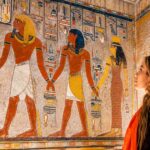
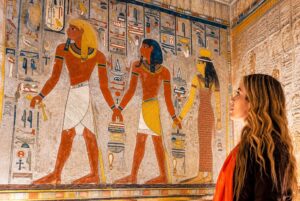
The most impressive features of this temple include beautifully carved limestone walls, detailed hieroglyphics, colorful reliefs, and religious scenes demonstrating Egyptian gods and pharaohs. The seven principal sanctuary chapels make this temple famous. This monument is a must-visit place for travelers looking to explore ancient Egyptian art and architecture.
2. Abydos King List
The Abydos King List is another important feature that makes the Temple of Seti I famous. This inscription has the names of 76 earlier Egyptian rulers; their arrangement is in chronological sequence. You will come to know how ancient Egyptians recorded their royal history.
However, remember that it is not a complete record. There are many rulers who are not included in the list, including Tutankhamun and Akhenaten, depicting the religious and political views of Seti I’s administration.
3. Osireion
The Osireion is another structure located behind the Temple of Seti I. Traditionally, its link with Osiris is observed, and it is famous for its central platform, huge granite pillars, and surrounding water channel. One thing that makes it different from other Egyptian temples is its architectural design, making it a top attraction for travelers. It is depicted as a symbolic funerary structure linked to Osiris. However, the exact meaning is a subject of debate. If you are planning to visit Osireion, you need to check local arrangements because access to it may be restricted.
4. Temple of Ramesses II
The Temple of Ramesses II is another essential monument located in Abydos. Much of the original structure has disappeared, but the rest of its remains still show architectural and artistic significance. The connection of the reign of Ramesses II with the temple can be seen through its inscriptions and scenes. If you want to understand the political and religious legacy of this Egyptian pharaoh, then you should visit this place.
5. Umm el-Qa’ab
Several early Egyptian kings were buried in Umm el-Qa’ab, which is an ancient royal necropolis. The name is translated as “Mother of Pots”, indicating the large quantities of pottery fragments found in the area. Archaeological excavations reveal early royal burial habits, the evolution of kingship, and Egyptian tombs. You need to check local arrangements because access to Umm el-Qa’ab for the public may be limited.
4. Best Time to Visit Abydos
- Upper Egypt is usually cooler between October and April, making it convenient for travelers to walk around and explore monuments.
- The weather is conducive for visits to the temples from October to November.
- December to February, when many tourists find the temperature to be comfortable.
- May to September can be very hot, and you may wish to visit early morning.
If you are travelling from Luxor, it is better to start early in the morning to enjoy your day.
5. How to Visit Abydos from Luxor
Luxor is another easy and comfortable starting point for a visit to Abydos. The drive is normally about 2.5-3 hours one way.
- Hired car: Opting for a hired car with a chauffeur will give you more freedom and time to visit the temple at your leisure.
- Guided tour in a group: Ideal for foreigners, the guided tour. Transport is sometimes included. Pick up at the hotel and an Egyptologist for guidance. Make sure to check what services and admissions are included.
Abydos is a good trip for anyone wanting to explore some ancient Egyptian temples.
Dendera or Abydos: you cannot miss the Temple of Hathor in Dendera, which has striking columns and stunning astronomical ceiling decoration. You can visit both sites on a long day trip from Luxor but leave early.
6. Can You Visit Abydos During a Nile Cruise?
Abydos would generally be excluded from the “classic” Luxor-Aswan cruise route because it is situated to the north of Luxor and off the direct sailing path.
Though, you may arrange a secondary tour from Luxor before you begin your cruise or can enjoy the tour after you complete your journey.
Alternatively, you may also be able to extend your cruise holiday to include the pyramids and other historical sites in and around Cairo, or go to the ancient places of Cairo, in addition to the main cruise. At Nile Cruisen, you might learn about different options for a Nile trip, along with luxurious, conventional, common, and Dahabiya Nile cruises.
7. Travel Tips for Visiting Abydos
Some tips to consider before traveling to Abydos:
- Begin the trip early if you are heading from Luxor.
- Comfortable walking shoes are essential when visiting the archaeological site.
- Carry drinking water, sunglasses and sunscreen.
- You might even want to hire a qualified Egyptologist guide to explain the inscriptions.
- Verify entrance fees and hours of operation before traveling.
- Verify access to the Osireion and other secondary monuments.
- Provide sufficient time to allow for a full return journey to Luxor.
Frequently Asked Questions on Abydos
-
What is Abydos known for?
Famous for the Temple of Seti I, the Abydos King List, the Osireion and the ancient religious link with Osiris.
-
How far is Abydos from Luxor?
Abydos is about 160-175 km by road from Luxor. The drive from Luxor to Abydos will normally take about 2.5 to 3 hours.
-
Who built the Temple of Seti I?
Pharaoh Seti I during the 19th Dynasty. His son Ramesses II continued the construction and decoration of the temple.
-
Can Abydos and Dendera be visited in one day?
Yes. A tour can be made to both temples from Luxor in one day, but leaving early in the morning is advisable.
-
Can you see Abydos on a Nile cruise?
No. Abydos is not a regular temple visited on traditional Luxor-Aswan Nile cruise routes. However, this can be scheduled as a special trip from Luxor.
-
What is the best time to visit Abydos?
October to April, when temperatures are milder than in the summer months.
Conclusion
Abydos is one of the most interesting tourist sites in Egypt, giving a glimpse of ancient Egyptian religion, kings, and their magnificent architecture. The destination is home to the extraordinary Osireion and the royal graves, and the awe-inspiring Temple of Seti I and the unique King List.
In your Egypt holiday itinerary, do not forget to include the temple of Abydos with Luxor, the temple of Dendera and the Nile cruise.
If you are looking to explore other monuments in Luxor and Aswan, you can book a Nile Cruise in Egypt by contacting Nile Cruisen.

This article was created by the team at Nile Cruisen, one of the best tour operators in Egypt for Nile cruises and tailor-made Egypt tours.
With years of experience sailing between Luxor and Aswan, our team knows the Nile better than anyone.
We share trusted travel advice, from the best time to visit and what to pack to simple tips for avoiding crowds.
Our goal is to help you enjoy the timeless beauty of Egypt with comfort, confidence, and an unforgettable travel experience.
- Nile Cruisen Team

- Nile Cruisen Team

- Nile Cruisen Team
- Nile Cruisen Team