 Nile Cruisen Team
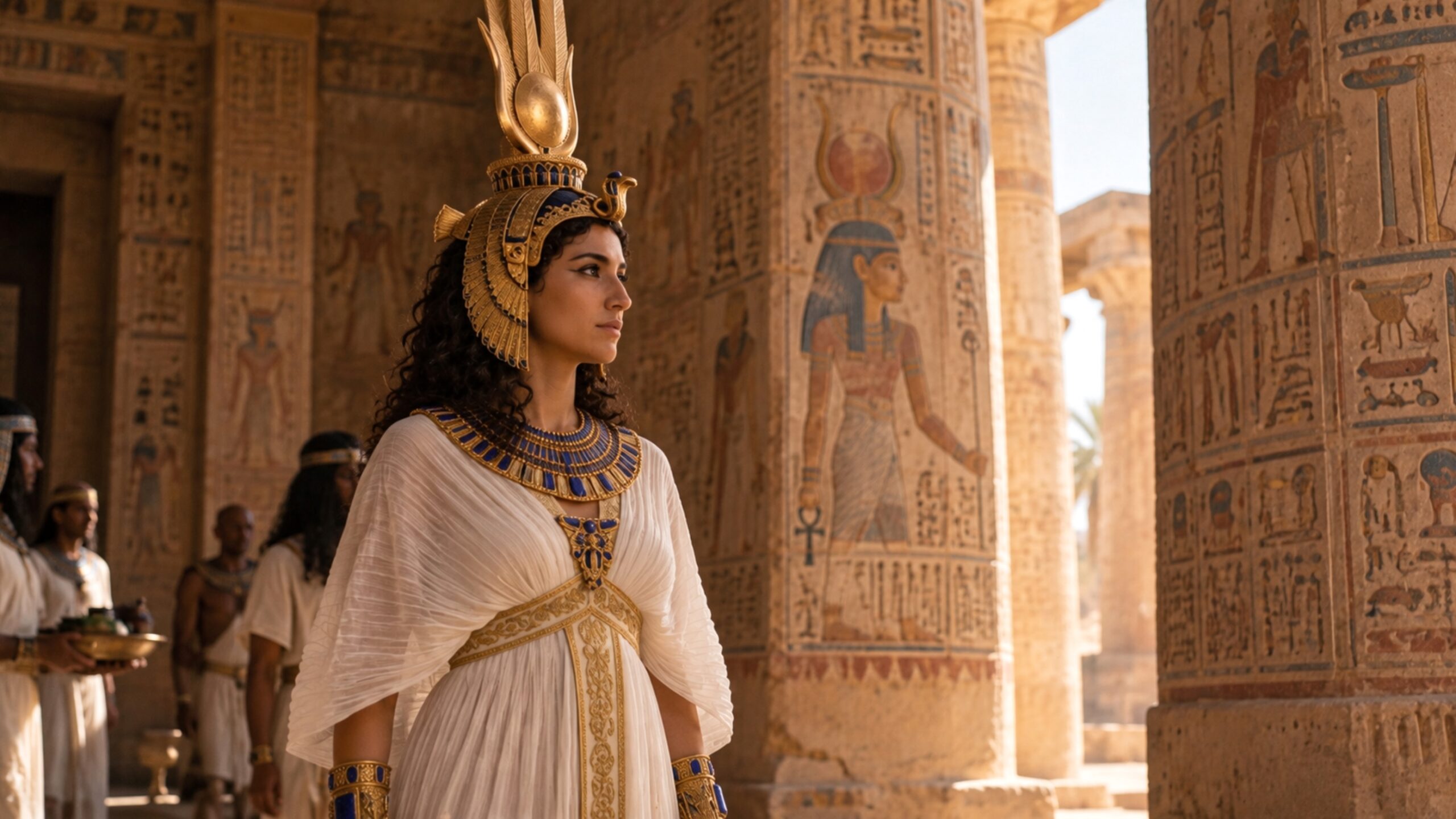
Cleopatra VII did not possess the physical beauty that Hollywood and dramatic works established in people’s minds, but her real appeal lay in another place. The stereotypical image of an enchanting queen who brought down the greatest Roman leaders just with a glance with her eye is actually a mix of an ancient Roman advertising, modern literary and cinematic fiction. When searching for archaeological clues and trusted historical testimonies, the image of a woman did not rely on her facial features, but on political cunning, encyclopedic knowledge, and an overwhelming charisma that made her one of the greatest figures in history.
Archaeological clues: Coins and statues
The most reliable image we have of Cleopatra comes from the coins that were made during her reign. On these coins, Cleopatra does not look like a symbol of classic beauty, but she appears with strong and sharp features:
- The prominent nose: Cleopatra appears with a prominent hooked nose (Looks like a hawk’s nose), which at that time was considered a sign of strong personality and sovereignty.
- Sharp chin and full neck: Her facial features are likely masculine, with a wide and prominent jaw.
This was not necessarily a one hundred percent reflection of her actual features, but it was a deliberate political decision. Cleopatra was a queen who ruled in a male-dominated world, and she wanted to imbue herself with the legitimacy of power. Therefore, she purposely had herself known with features that look like her Ptolemaic ancestors (especially the founder of the dynasty, Ptolemy I), to send a message to her people and enemies that she was a strong ruler no less than male kings, and not just like a beautiful female
The few remaining marble heads believed to belong to her (like the Berlin and the Vatican statues) show a woman with attractive and proportionate features, but she does not rise to the level of exceptional legendary beauty.
Testimonies of ancient historians: The magic of mind and voice
The Greek historian “Plutarch,” who wrote a book about Cleopatra a century of her death and is considered one of the most important classical sources about her life, firmly settled this controversy. He wrote Cleopatra body beauty “was not unique in itself , and was not from the type that astounded those who saw her.
But Plutarch explains the secret of her strength and her actual attractiveness: her charm was in her overwhelming presence:
- Voice sweetness: Plutarch described her voice as “Like a multi-stringed musical instrument”; she had the ability to speak in a tone that captured the attention of everyone who listened to her.
- Captivating speech: She had an extraordinary ability to persuade, quick wit, and a charming conversational style that made it impossible for any man to ignore her or resist her impact.
- Charisma:* Her presence and interactions with others were surrounded by an aura of attraction that completely overshadowed her facial features.
The Roman propaganda machine: Manufacturing the myth of seduction
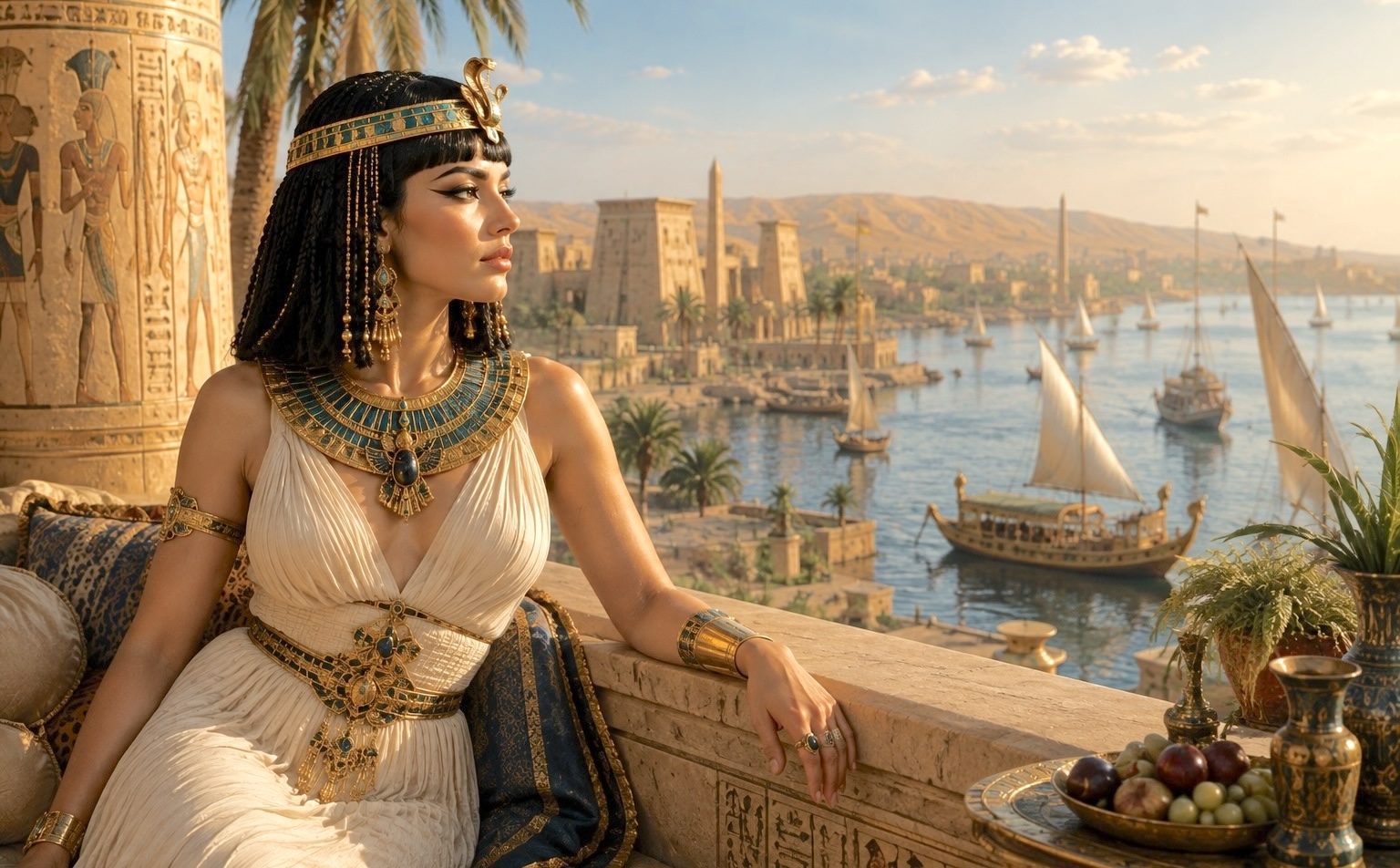
If Cleopatra was not overwhelming beauty, then how was her name linked with lethal seduction? The answer lies in ancient Rome, when Julius Caesar, and then Mark Antony, formed a political and romantic alliance with Cleopatra; that was like a shock and a threat to the Roman Empire. Antony’s arch-enemy, Octavian (who later became Emperor Augustus), needed a political justification to destroy Antony and declare war on Egypt.
It was unacceptable in the male-dominated Roman society to admit that two of Rome’s greatest leaders had negotiated and submitted with a foreign queen due to her intelligence and her political acumen, and strategic superiority. Instead of that, Octavian launched a fierce anti-propaganda campaign photos that Cleopatra was an evil foreign witch and royal prostitute, that used her beauty and dark magic to seduce the Rome leaders and strip them of their minds.
This Roman campaign achieved their goal, but also created a myth that has lived two thousand years: the myth of the woman who brought down empires with her physical beauty, ignoring the fact that her actual weapon was her brilliant mind.
The true beauty: Encyclopedic culture and political astuteness
The charm that ensnared Caesar and Antony in Cleopatra’s web was from her being an intellectual and political peer.
- Linguistic genius: Cleopatra was the first ruler of the Ptolemaic family to take the trouble to learn the ancient Egyptian language to communicate with her people. In addition, she was a fluent speaker of no less than 8 other languages, including Ethiopian, Hebrew, Arabic, Syriac, Median, and Parthian. She was able to negotiate with ambassadors and kings without the need for any translators, and it was rare and impressive in the ancient world.
- An advanced education: She studied at the Library of Alexandria, the center of the ancient world. She studied mathematics, philosophy, rhetoric, astronomy, and medicine. When Caesar spoke with her, he was not speaking to his love, but to an expert in political geography and economics who could manage one of the wealthiest states in the Mediterranean.
- Theatrical mastery of power: Cleopatra was a woman of first impression. When she met Mark Antony in the Tarsus city, she was not relying on her beauty, but she arrived on a boat with golden sails, silver oars, and purple sails, embodying the goddess Aphrodite, surrounded by music and incense. She knew how to use art, religion, and dramatic presentation to win minds before hearts.
The myth of absolute beauty that later Elizabeth Taylor and Vivien Leigh embodied it on screens, the truth obliterated. Cleopatra VII did not need an angelic face to create the history; she had a strategic scary mind, a broad education, and remarkable self-confidence that made her manipulate the strongest men in Roman Empire. Her magic was not in her features, but in her ability to rule a whole world with her strong personality, which making her one of the most extraordinary queens in human history.