 Mokhtar Yonis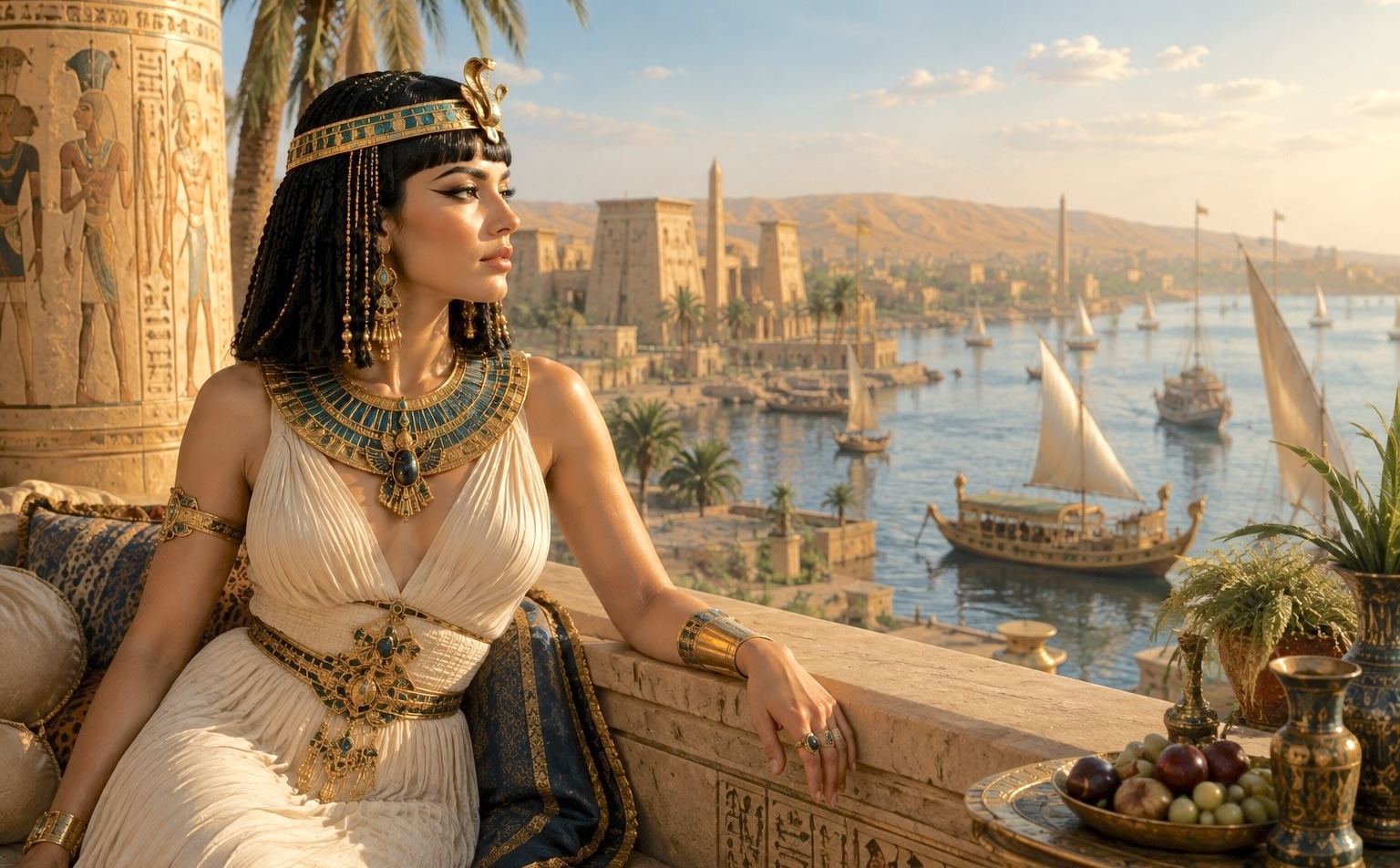
Cleopatra VII is considered as the Queen of Ptolemaic Egypt, one of the most influential people in the history, representing a symbol of political and beauty control. Cleopatra was born at 67 BC and assumed power in 51 BC, and she was the last queen in ancient Egypt. Distinguished by her political acumen and her ability to handle the increasing Roman influence in her country, which makes her a pivotal person in a complex historical period. Cleopatra spoke many languages, and that helped her to make a strong diplomatic relation with the leaders of the ancient world.
Cleopatra embodies the image of the strong woman that seeks to preserving her kingdom that suffers from internal and external pressures. She used her charm and appeal to attract leading people like Julius Caesar and Mark Antony, seeking to secure her kingdom and throne through strategic alliances. These relations contributed to foster her power, regardless of that she also placed her in the arena of political conflict throughout history.
Cleopatra transformed into a symbol of femininity and strength, and it has been a subject of numerous literary and artistic works, which makes her a subject for researchs and studies across the age. Many novels and legends revolve around her life, she blends between facts and imagination, which arouses the curiosity of historians and enthusiasts. Regardless of the historical facts we know, Cleopatra’s impact remains more than just a queen, as she embodies story of a woman that distinguished by courage and perseverance in a world dominated by patriarchal authority.
Cleopatra was born at 69 BC in Alexandria, she is one of the most prominent royal people in Ptolemaic Egypt. Cleopatra was a part of the Ptolemaic royal family, which is a Greek dynasty that ruled Egypt after the great Alexander dead. Her father, Ptolemy XII, he was a weak king faced an internal and external conflicts that led to problems in his rule. Her mother, although her name is uncertain, there’re suggestions that she was from a royal family too. This familial background, along to political ambitions, saved to Cleopatra a special beginning in her life.
Cleopatra received an exceptional education that was focused on philosophy , science, language. She spoke several languages fluently, including Greek and Egyptian, which make her to communicate with different people, this integrated education contributed to shaped her mind of governance, she influenced by the different cultures that gathered in Egypt, therefore she believed that the role of the king should be beyond ruling, it must be a cultural body that connecting peoples.
Cleopatra influenced by ancient Egyptian cultural heritage, which respected divinity in rule, and also the Greek culture which prevailed at that time. This diversity culture helped her in develop effective political strategies when she ascended throne. Cleopatra was looking to return Egypt to its position as a superpower in the region through her balancing of different cultures, which makes her an unique character in the history of Ptolemaic Egypt.
Cleopatra VII is considered as one of the prominent rules in the history of ancient Egypt, her accession to the Throne linked to the complex events that connecting to the royal family and the country’s political conditions. Cleopatra was born in 69 BC, she was the only daughter of King Ptolemy XII. In 51 BC, Cleopatra ascended the Throne as co-ruler with her young brother Ptolemy XIII, but the political circumstances in that time led to major challenges to her power.
At the beginning of her reign, Cleopatra faced internal conflicts and external forces threatening Egypt’s stability. Her brother Ptolemy XIII was supported by his advisors and a faction of the army, which shaped a obstacle to her rule. Under these circumstances, Cleopatra relied on many strategies to secure her power. The most prominent of these strategies was forging alliances with prominent Roman leaders such as Julius Caesar, who provided a military support against her brother.
Securing the Throne was not just a race for the power, it also required political acumen and a strong diplomatic sense. Cleopatra at the end could take the control from her brother, and through a political marriage arrangement with Caesar, and he enhanced her position and allowed her greater control over Egypt affairs. These relations contributed to fostering Egypt positionban important power in international affairs during that period, making Cleopatra a legend character transcending the country’s borders. Cleopatra’s ascent to the throne is considered a turning point in the history of Ptolemaic Egypt, as she became a symbol of power and political intelligence.
The relations that Cleopatra VII established, the last kings of the Ptolemaic Kingdom of Egypt, with the Roman leaders are considered the most decisive missions in ancient Egyptian history. Cleopatra was able to use these relations to foster her political and social positions, not only in Egypt, in all the region. These relations began with her meeting Julius Caesar, he had strong impact during that period. After Caesar sailed to Egypt in 48 BC, Cleopatra made a strategic alliance with him. Thia alliance was not only for securing her monarchy, but to restore Egypt to its previous historical position.
The cooperation with Caesar resulted is an unofficial political marriage between them, and the appointment of her son, Caesarion, to the throne. After assassination of Caesar in 44 BC, Cleopatra found her self needs to look about a new ally. Here came the role of Mark Antony, who was one of the most prominent Roman leaders after Caesar. This cooperation turned into a strong personal relationship between Cleopatra and Antony, which led to conclusion of many political and commercial agreements between Egypt and Rome. These relations were crucial in enhancing Egypt’s military and diplomatic strength, its position on the international political scene grew.
Therefore the relations with Rome were full of dangers, Cleopatra faced many of internal and external challenges. Despite her strong alliance, there was a strong opposing forces in Rome that questioned Egypt’s power and stability. Resulted events such as the Battle of Actium in 31 BC led to the end of Cleopatra’s rule in Egypt, it was a huge turning point in the Egyptian and Roman history. These Roman relations are considered an example of how Cleopatra used her political acumen, but also highlight the complexities of balancing alliances and political interests at the time.
Cleopatra VII is considered one of the historical figures most frequently portrayed and whose story has been retold across the years. It not reflects her cultura legacy only , it indicates also to her impact on literature, cinema, and the arts at all. Since ancient years, Cleopatra has been a source of inspiration for writers and artists, in western literature, for example, many literary works have addressed topic of her political and emotional life, which contributed to shaping the image of the strong woman who challenged the prevailing norms of her era.
Cleopatra appears prominently in Shakespearean plays, where she represents a symbol of love and betrayal, adding a spiritual dimension to her character. In cinema, she was embodied in famous movies such as Cleopatra movie in 1963, where Elizabeth Taylor played her role. That served to reintroduce her iconic story to new generations, helping to spread the legend of Cleopatra in popular culture. Cinematic are construction one of the examples that indicates to how to contain her story and her impact on the viewers across the time.
In addition, Cleopatra’s legacy manifests in fine arts, as she has been depicted in many of painting and sculptures that reflects her beauty and strength. That indicates to how she became a symbol of elegance and female strength in the western civilization. That is considered evidence of Cleopatra’s influence on shaping culture and arts over years, her story is continues inspire generations through the diversity interpretations and multiple approaches that address it.
What was daily life during Queen Cleopatra’s era?
During queen Cleopatra’s rule, the daily life in Ptolemaic Egypt was characterized by great complexity and cultural diversity. The Egyptian society in that time was divided into multiple social classes, where each class having its own rights and duties. The king himself, Cleopatra, were symbol of sovereignty, while farmers formed the base of the pyramid.
On the economic side, agriculture was the backbone of the Egyptian economy. The fertile lands that the Nile Valley is distinguished enabled grain production, while the secondary colors of agriculture like grapes, olives, and flax—boosted the local economy. Farmers used traditional effective agriculture methods, allowing them achieve stable levels of production. Trade played a major role in daily life, merchant caravans traveled between Egyptian cities and neighboring countries, contributing to enhancing economic and cultural exchange.
In the fields of arts and architecture, this period witnessed development. Temples and places became famous by their complex designs and rich decorations, reflecting the Greek and Roman impacts. Artists created works of art religious and political aspects, these works became part of the Egyptian identities. Theater and music have a role in the cultural life, entertainment performances were presented at the public events.
Overall, Cleopatra’s era embodied a mix of cultural openness and social innovation, which create a rich and integrated environment that left a clear mark on the history of ancient Egypt.
Cleopatra’s VII the last queen of Ptolemaic Egypt is considered one of the most historical controversial and mysterious people. Many myths and legends are refer to her rule, which makes it necessary to analyze the difference between the historical facts and popular legends . Many of people believed that much of what we know about Cleopatra today it has been influenced by literary and cinematic works, which has led to distortion of her true image.
One of the permanent legends relates to her extraordinary beauty, which was described by exceptional to the point that she brought down great men like Julius Caesar and Mark Antony. But, in reality, Cleopatra was more than just external beauty; she had a massive amount of intelligence and political astuteness, which helped her to save her power in a period dominated by political tensions. Cleopatra known by speaking several languages, reflecting her high education level and her ability on negotiate in historical crises.
Many of historians point out Cleopatra was not just a queen ruled a poetry steeped in myths. In reality, she was seeking to develop Egypt and reforms that would preserve her position in the course of history. While popular culture as a seduction political, it was necessary to break the stereotype surrounding her and understand the historical context in which she lived.
These legends and myths reveal how culture and civilization influence in shaping the historical figures. Through studying Cleopatra far away from romance and legends, we learn the importance of critical thinking in understanding history and providing an accurate picture of such complex figures.
What happened to Cleopatra?
The end of Cleopatra VII is one if the most dramatic chapters in the history of Ptolemaic Egypt, which the events focused around the power struggle that arose after the death of Julius Caesar. After Caesar assassination in 44 BC, Cleopatra faced great of difficulties in saving the power, Mark Antony, her love, waged a war against Octavian, the rightful heir to Caesar. Antony and Cleopatra tried to defend their kingdom against Octavian’s frantic ambitions, but matters unexpectedly.
In the famous battle Actium 31 BC, Cleopatra and Antony’s forces suffered a defeat at the hands of Octavian’s fleet. This military failure led to several consequences, including loss the control over lands and resources. After battle, Antony and Cleopatra escaped to Alexandria, but the matter was extremely difficult, as the end loomed on the horizon.
With Octavian’s advance towards Alexandria. Doubts and psychological collapses increase to Cleopatra, She started realize that her rule in the danger. In her way to escape from the family Cleopatra made a tragic act in 30 BC when she chose to end her life by poison. This moment is considered onr of the most prominent influential historical milestones, as it led to the disappearance of the Ptolemaic dynasty and open the last chapter in the history of ancient Egypt.
Cleopatra’s death had massive impacts on the history of Egypt and whole world, as the countries transitioned to the rule of Octavian and later became part of the Roman Emperor. The events of Cleopatra’s end lights on the political conflicts and battles witnessed that period, which conforming the complexity of ancient Egyptian history and its dimensions impacts on the course of civilization.
- Cleopatra’s VII remains one of the most mysterious and intriguing people in history, as they viewed her as a symbol of strength and intelligence. Cleopatra was the last queen of Ptolemaic Egypt, reflects the complex political ambitions that dominated her era, and she embodied the strength battles between Roman Empire and Mediterranean countries. Cleopatra took strategic steps to support her rule, as she sought to immense power through political alliances with leaders such as Julius Caesar and Mark Antony.
- Cleopatra’s impact on history doesn’t stop at her being a smart ruler, it extends to her profound influence on culture, art and literature. Cleopatra wasportrayed in many literary and artistic works, as she became a symbol of beauty, intelligence and feminine influence. Her story plays an important role in understanding the cultural history to Romans, Greeks and Egypt, providing us lessons in negotiation and leadership.
It is very important to consider Cleopatra in her historical context. She faced massive pressures to secure her throne amidst the political conflicts, which shows us the importance of diplomatic strategies and the effective negotiation in rule. Her story emphasizes that the leadership not just about power, it also about the ability to build relationships and influence on your future. Studying Cleopatra’s life can offer us a valuable ideas about the challenges that female leaders face today.

Mokhtar Yonis
A professional tour guide since 2008, I have led thousands of tours all over Egypt. As an Egyptologist with a Master's degree in Egyptology from Cairo University, I bring a deep knowledge of and passion for Islamic history, monuments, and modern Egyptian culture. A Cairene for most of my life, I joined NileCruisen company in 2016 as a professional tour guide and travel editor.
- Mokhtar Yonis
- Mokhtar Yonis

- Mokhtar Yonis
- Mokhtar Yonis