 Mo Kamal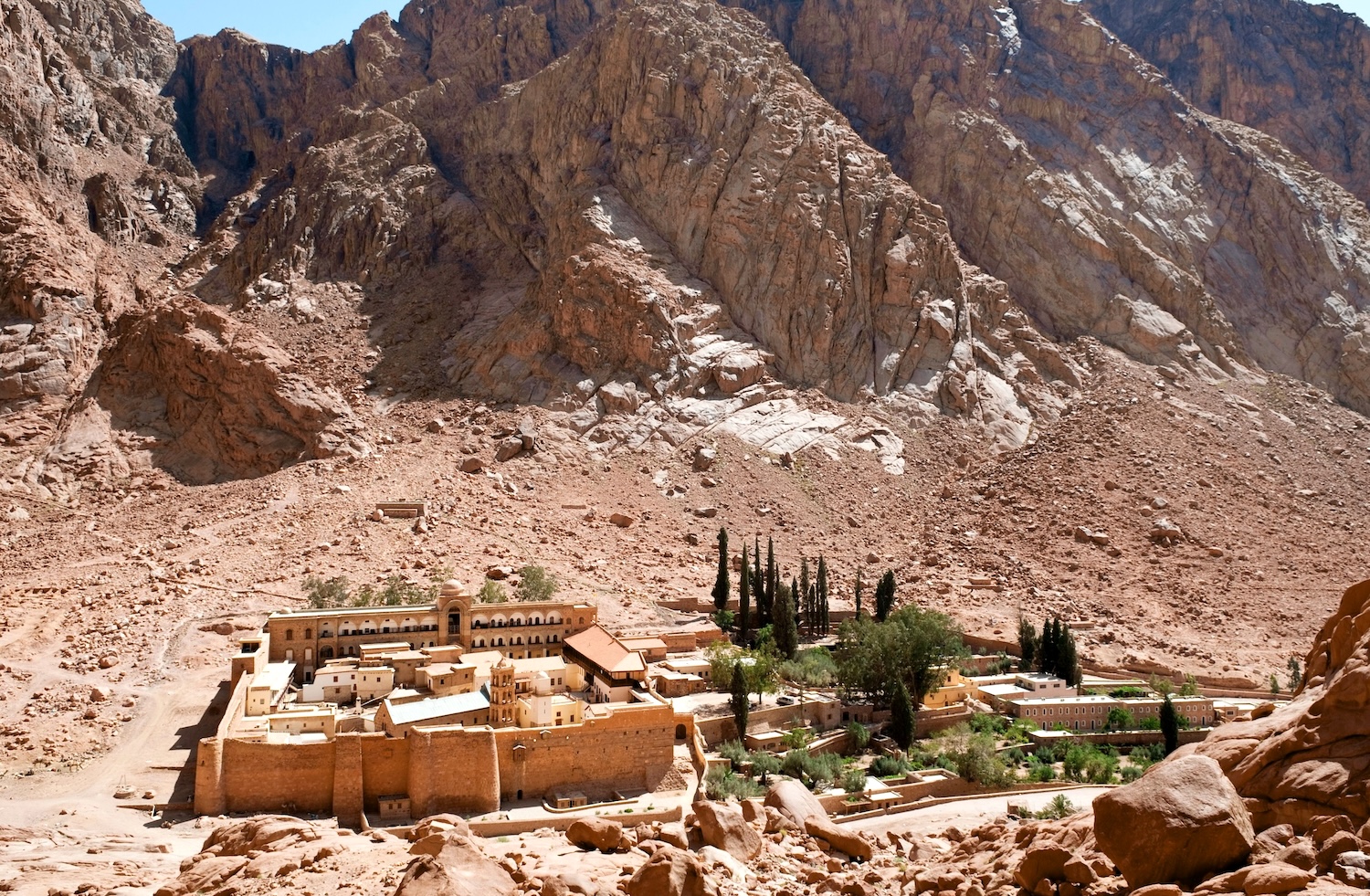
St Catherine’s Monastery is a Christian monastery in the Sinai Peninsula of Egypt. It was built between 548 and 565 AD, located at the foot of Mount Sinai, and is considered the world’s oldest continuously inhabited Christian monastery. It was built by the order of the Byzantine Emperor Justinian I, around the place believed to be the burning bush that Moses saw. After so many years, the remains of Catherine of Alexandria were believed to have been found nearby and brought to the monastery. Due to this reason, the monastery became a crucial place for Christian pilgrims and was later named after Saint Catherine.
The monastery is managed by the autonomous Church of Sinai, which is associated with the wider Greek Orthodox Church. In 2002, it became a World Heritage Site due to its importance to Judaism, Islam, and Christianity. The monastery also has a historic Fatimid mosque built in 1106 AD that still exists today. The library of the monastery has many valuable and rare books and manuscripts, including the Codex Sinaiticus and the Syriac Sinaiticus. It also contains a collection of very old Christian icons, including the earliest known image of Christ Pantocrator.
Table of Content
-
Where is Saint Catherine’s Monastery Located?
-
When was st catherine monastery built?
-
Saint Catherine’s Monastery History
-
Can you visit st catherine’s monastery?
-
Saint Catherine’s Monastery Visiting Hours
-
St Catherine’s Monastery Facts
-
Is It Safe to Visit St Catherine’s Monastery?
-
Saint Catherine’s Monastery tickets
-
Where is Mount Sinai in Relation to Saint Catherine?
-
What to Do in Saint Catherine
-
What Should You Wear When Visiting?
Where is Saint Catherine’s Monastery Located?
Saint Catherine’s monastery is located at the foot of Mount Sinai.
When was st catherine monastery built?
It was built in 548-565 AD by the order of the Byzantine Emperor Justinian to house monks who had been living in the Sinai Peninsula.
Saint Catherine’s Monastery History
One of the oldest records of monks living at Mount Sinai comes from a Latin travel diary written by a Christian pilgrim named Egeria around 381-386 AD. By order of Byzantine Emperor Justinian I, the monastery was built around the Chapel of the Burning Bush, which had earlier been constructed by Helena, mother of Constantine I, at the place where Moses is said to have seen the burning bush. The bush today is traditionally believed to be the same one. The monastery also has the world’s oldest surviving wooden roof truss.
During the time of the First Crusade and afterward, various European Christian pilgrims visited the monastery. In the Middle Ages, monks there came from many backgrounds, including Greek, Arab, Syrian, Georgian, and Slavonic communities. Later, during Ottoman rule, it became mostly Greek Orthodox. Princes from Wallachia also provided donations to support the monastery.
During the Fatimid Caliphate, one chapel was turned into a mosque, which is still in use on special occasions. In the 7th century, the most isolated Christian hermits in Sinai disappeared, leaving only the fortified monastery protected by a high entrance and strong walls.
The monastery creates the center of the Church of Sinai, led by an archbishop who is also the abbot. Some consider the church completely independent, while others see it as associated with the Greek Orthodox Patriarchate of Jerusalem. During the Crusades, both Byzantine rulers and the Kingdom of Jerusalem supported the monastery despite tensions between Orthodox and Catholic Christians.
In the 1400s, traveler Felix Fabri described the monastery’s large gardens filled with fig, olive, and pomegranate trees. Later, the monastery declined as the Mamluk Sultanate weakened. Bedouins attacked and robbed its property, and the monastery itself was looted in 1505. The decline was noticed by the explorer Marin von Baumgarten, who visited it in 1507. In 2017, militants from Islamic State – Sinai Province attacked a checkpoint near the monastery, killing one police officer.
In 2025, an Egyptian court ruled that the monastery can use its land, but the land officially belongs to the state as a protected historical site. This caused concern in Greece and among the Greek Orthodox Church because Egypt is developing the area for religious tourism. Egyptian leaders later promised to protect the monastery’s religious independence.
Later in 2025, Symeon VI became the new archbishop. However, Egypt says the monastery’s abbot must be an Egyptian citizen to legally represent it in official disputes.
Can you visit st catherine’s monastery?
Yes, you can visit St. Catherine’s monastery. It is open to the public, though hours are limited.
Saint Catherine’s Monastery Visiting Hours
Saint Catherine’s Monastery is usually open for visitors from 8.45 AM to 12:45 PM on Saturday through Thursday. However, on Friday, the monastery is open from 10:30 AM to 11:30 AM. The monastery closes on Sundays and other important feast days.
St Catherine’s Monastery Facts
You might be interested in learning about the factors of St. Catherine’s monastery. Take a look at the facts below:
- The monastery has more than 6,000 manuscripts and rare books.
- It has a wide collection of early Christian icons, some of them dating back to the 5th and 6th centuries.
- It is considered a sacred site for three major Abrahamic religions, and even has a 12th-century Fatimid mosque inside its walls.
- It is located at the foot of Mount Sinai, where Moses is said to have received the Ten Commandments.
- The monastery was built to protect the burning bush seen by Moses.
Is It Safe to Visit St Catherine’s Monastery?
Generally, visiting St. Catherine’s Monastery is considered safe when the travel journey is provided by an expert tour operator and follows security guidelines.
Saint Catherine’s Monastery tickets
You generally do not need a ticket to visit Saint Catherine’s Monastery itself. Entry to the main monastery complex is typically free or has only a very small local fee collected onsite. Most visitors simply arrive and enter during visiting hours.
Where is Mount Sinai in Relation to Saint Catherine?
Mount Sinai is located about two miles from Saint Catherine’s Monastery, making it easy for visitors to see both places in one trip. The mountain is 7,497 feet (2,285 meters) tall and an important religious site in Judaism, Christianity and Islam. Many tourists visit every year to climb the mountain, enjoy the sunrise, and experience its spiritual importance.
What to Do in Saint Catherine
The main attraction in Saint Catherine is Saint Catherine’s Monastery. Many visitors arrive by car, while others climb Mount Sinai to enjoy the beautiful mountain views along the way. There are different hiking routes available depending on your fitness level.
Near the monastery, you can also visit important religious sites such as Moses’ Well and the Burning Bush. Many guided tours include these places as part of the visit.
Visiting the nearby Bedouin villages is another popular activity, where you can experience the local culture, traditional food and Bedouin hospitality.
What to Wear When Visiting?
If you are planning on visiting Saint Catherine’s Monastery, you need to dress well to respect the religious significance of the site. Men and women both have to wear clothes covering knees and shoulders. In the hot months, remember to wear comfortable and light clothes.
If you’re heading up Mount Sinai, definitely pack some sturdy hiking boots or comfy sneakers—the trail is pretty rocky and uneven.
Make sure to pack some warm clothes, too—the mountains get surprisingly freezing at night and first thing in the morning.
And since the daytime sun is super intense, make sure you have a hat, sunglasses, and plenty of sunscreen.
What Is the Best Time to Visit Saint Catherine’s Monastery?
The best time to head to Saint Catherine’s is between October and April. It’s way nicer to explore the monastery and hike the mountain when it’s cooler out—trying to do all that in the summer heat is pretty brutal.
Many visitors prefer to arrive in the early morning, to avoid the crowds and enjoy the peace and quiet around the monastery.
Sunrise trips are particularly popular if you’re planning to hike Mount Sinai as they provide beautiful views of the mountains around. Summer visits are possible, but temperatures in the Sinai region can become very hot during the day. Winter months are cooler, although nights and early mornings can be quite cold.
Is Photography Allowed Inside Saint Catherine’s Monastery?
In the outdoor areas of Saint Catherine’s Monastery, visitors are usually allowed to photograph the buildings, walls and nearby mountains. However, in some religious areas, chapels or museums, taking of photographs may be forbidden to protect the old icons and manuscripts.
Visitors should respect the rules of the monastery and always ask permission before taking pictures in sensitive areas. When you visit, it is also important to be respectful of worshippers and religious ceremonies.
Conclusions
Saint Catherine’s Monastery is among Egypt’s most significant religious and historical sites. Providing a distinctive experience for visitors interested in culture, spirituality and history, with its rich history, ancient manuscripts and close proximity to Mount Sinai.
If you want to see more of Egypt’s historical treasures, you can also book a 3-night Nile cruise with Nile Cruisen for an unforgettable trip along the Nile.

Mo Kamal
Mohamed "Mo" Kamal is one of the leading Egyptologists in Luxor and Aswan. With a strong academic background and a deep passion for ancient Egyptian history, he brings every site to life with engaging stories and expert knowledge. Mo joined the Nile Cruisen team in 2017 and has been creating unforgettable experiences for our guests ever since. He is also a writer and researcher, specializing in the history and architecture of ancient Egyptian temples, tombs, and monuments.
- Mo Kamal
- Mo Kamal
- Mo Kamal
- Mo Kamal