Who is Egypt’s most famous pharaoh?
Table of contents
-
Introduction
-
Who were all the pharaohs of Egypt?
-
Narmer
-
Djoser
-
Khufu
-
Hatshepsut
-
Thutmose III
-
Tutankhamun
-
Ramesses II the great
-
Cleopatra VII, the Philopator
-
-
Who is the greatest pharaoh of Egypt?
-
How many pharaohs ruled Egypt?
-
Final thoughts
Introduction
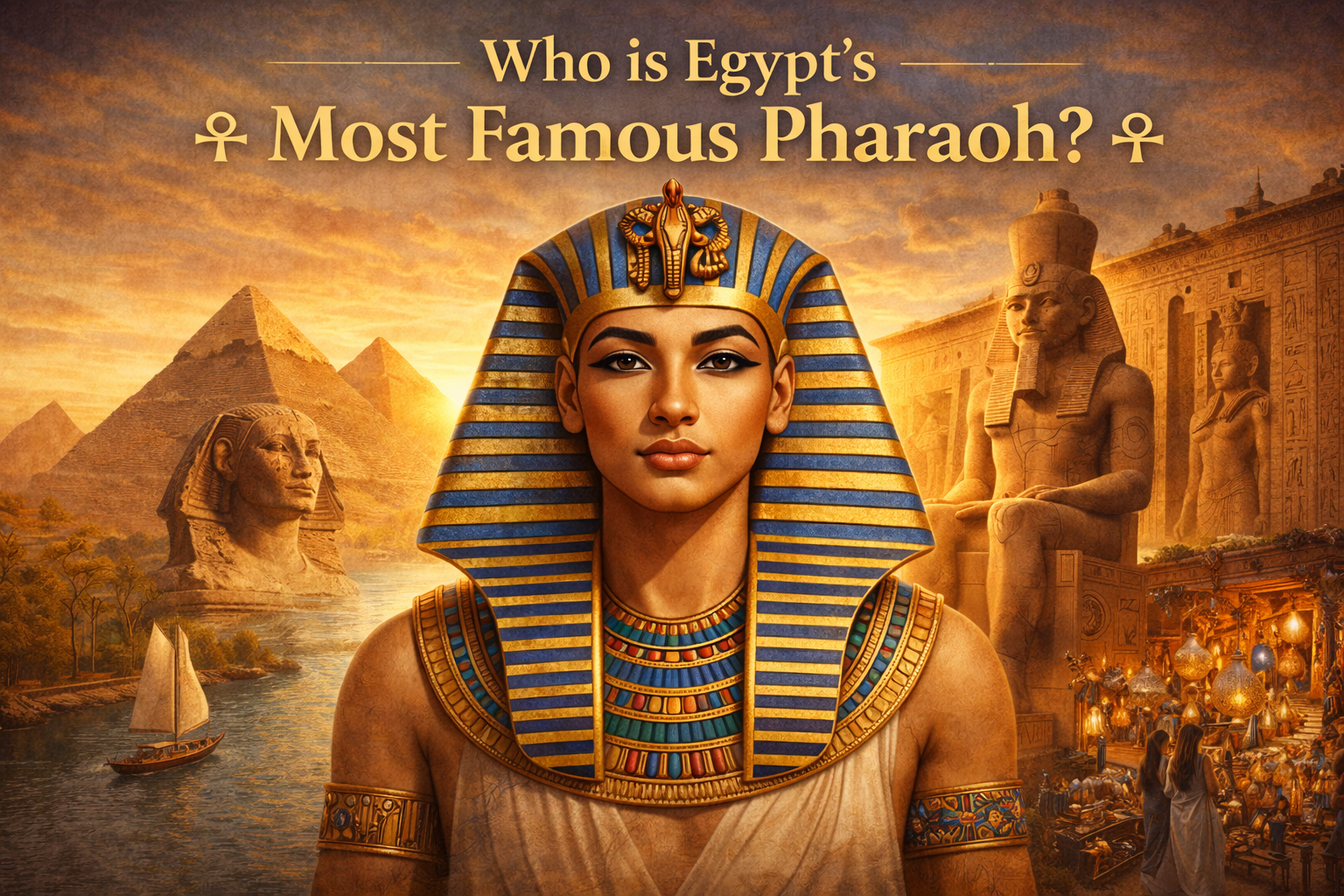
The most famous pharaoh of Egypt is not amongst the strongest ones but a child pharaoh, who is Tutankhamun, because he is the only pharaoh from ancient times whose tomb is found nearly intact. It provided deeper knowledge to the archaeologists about the burial practices of the ancient times in Egypt.
From the very beginning, Egypt was the home to the pharaohs who ruled the desert land and the longest river, the Nile. The rich history and heritage of pharaohs are seen through the massive monuments situated across Egypt, from pyramids to temples in Luxor and Aswan.
Below in this piece of content, we are mentioning the major pharaohs in Egypt who have ruled at different time lines in Egypt and contributed to shaping it. From the pharaohs of the first dynasty to the last active pharaoh, a list of Egyptian kings is here, a traveler to Egypt must-know.
Who were all the pharaohs of Egypt?
Narmer
The king Narmer belongs to the early Dynastic period in Egypt and is believed to be the first pharaoh. He ruled around 3100 BCE and contributed to history by unifying upper and lower Egypt. King Narmer is one of the legendary kings of Egypt and usually wore a crown with red and white bands that represented the unification of the north (Lower Egypt) and south (Upper Egypt).
Djoser
He was the first pharaoh of the third dynasty in Egypt, ruling around 2670 BCE. The Egyptian pharaoh is seen as the first to introduce the construction of pyramids for honoring the afterlife of a pharaoh. He ruled over an ancient Egyptian city famous because of the step pyramid of Djoser, a flat-roofed mastaba with a height of 62 meters. His reign is known for architectural marvels and construction in Egyptian history.
Khufu
The great pharaoh Khufu ruled during the fourth dynasty of the Old Kingdom in Egypt, and he ruled from 2589 to 2566 BCE. He is famous and widely known because of the construction of the Great Pyramid of Khufu in Giza. which today stands as the identity of Egypt; his contribution to architectural wonders is remarkable.
Hatshepsut
Egypt’s most famous female pharaoh is the great queen Hatshepsut, who ruled over Egypt as the fifth pharaoh in the 18th dynasty. Her period of ruling is considered the era when political stability peaks, and she also commissioned a number of architectural wonders; one of those is the mortuary temple of Hatshepsut. In the cliffs of Deir el-Bahari, a beautiful temple is situated, which is dedicated to the god Amun. It is believed by the archaeologists that she is also known as the “Lady of the Two Lands,” which shows her legitimacy and solidification.
Thutmose III
The sixth pharaoh of the 18th dynasty in the New Kingdom, also known as the Napoleon of Egypt, is Thutmose III. During his regime from 1479 to 1425 BCE, the military of Egypt became the strongest of all time. He is known for his bravery and believed that he never lost a battle during his ruling time. Today his tomb is at the Valley of the Kings in Luxor, and tourists can see his tomb and unique wall carvings that tell the story of his mastery in power.
Tutankhamun
The youngest pharaoh of Egypt was believed to be king at a very young age, around 8 or 9, and surprisingly, he was not famous for any milestones but because of the discovery of his tomb. In Egypt the Valley of the Kings is looted several times because in burial practices gold and precious items are buried, which attracts traders and looters over time during invasions.
In 1922, with the discovery of his tomb, he became a famous pharaoh, as his tomb was found nearly intact. Also, the Grand Egyptian Museum in Cairo houses the 5,000 artifacts of Tutankhamun that were found in the tomb. Tourists can see his tomb while on the Nile cruise in Egypt, during the Luxor visit in the itinerary.
Ramesses II the great
The most powerful pharaoh in Egyptian history is known as Ramesses II the Great; his regime is seen as the golden age for ancient Egypt. He ruled from 1303 to 1213 BCE and was the third pharaoh in the 19th dynasty. His regime was as long as around 66 years and also famous for the construction of temples like Abu Simbel and significant contributions at the Karnak temple, and he commissioned the Nefertiti temple for his wife near Abu
At the grand museum in Egypt, tourists can see a massive cut-stone statue of Ramesses II. A tomb is also located in the area of the kings that can be explored by tourists during the Nile cruise from Luxor with the tour guides on the package deals.
Cleopatra VII, the Philopator
She is the last active pharaoh of the Egyptian Ptolemaic age, widely known for her intelligence and political influence in building relations with Roman empires. She allied with great rulers like Julius Caesar. She is not a native Egyptian; she learned the Egyptian culture and preserved Egyptian traditions during her regime. With her death, the Egyptian pharaoh rule also came to an end, and Egypt became a land ruled by Roman kings.
Who is the greatest pharaoh of Egypt?
Ramesses II is one of the greatest pharaohs of all; his regime was seen as the golden age in Egypt. It believed that he fought the famous battle of Kadesh and also contributed a lot to the architecture of Egypt. Commissioned numerous temples and historical sites that today stand as proof of rich Egyptian culture.
How many pharaohs ruled Egypt?
Egyptian history is a 3,000-year-long history during which around 170 pharaohs have ruled over Egypt at different times and during different kingdoms. All these have contributed to shaping the unique history of Egypt.
Final thoughts
Pharaohs in Egypt are seen as major figures; their leadership and determination have shaped Egyptian history. Today, the famous historical sites and temples that tourists see are made by the pharaohs who preserved them through wall carvings for the generations to come; they have kept history alive over centuries, and their modern preservation is continuing to do the same.
Other Useful Links
A Traveler’s Guide to Gebel el-Silsila
Trusted Partners
Nile Cruisen: Chosen by Leading Brands as Egypt's Top Cruise Operator