 Nile Cruisen Team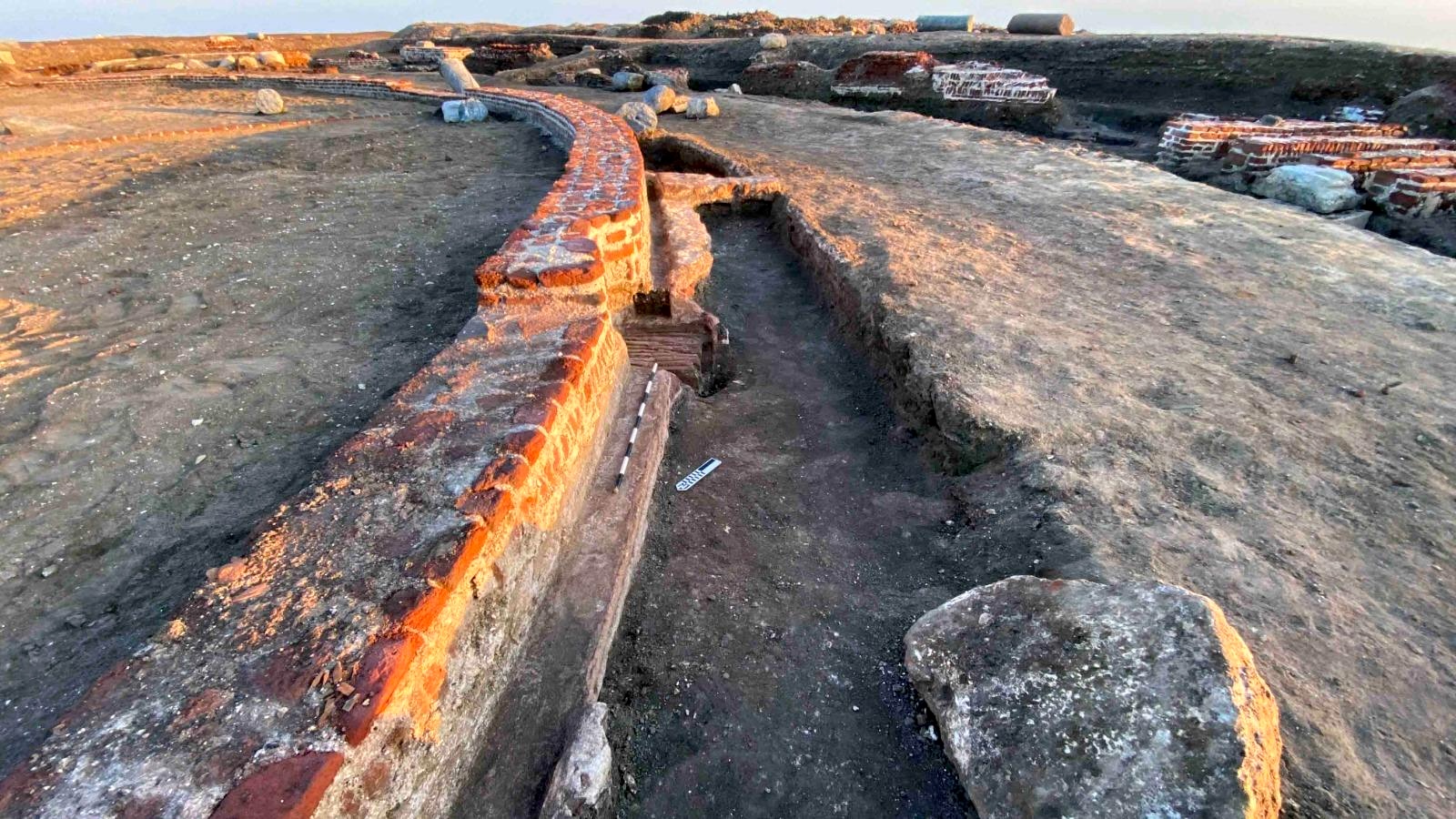
In a new archaeological achievement that reflects the richness and diversity of Egyptian heritage, excavation work in the archaeological city of Pelusium in North Sinai revealed the remains of a temple dedicated to the worship of the local god “Plusius,” in a discovery that sheds light on the city’s place in the ancient world, and rereads its role as a religious and cultural center in which Egyptian, Greek, and Roman civilizations interacted over many centuries.
– Discovery of the Temple of Pelusius at Tel Pharma
The Egyptian Archaeological Mission affiliated with the Supreme Council of Antiquities announced the discovery of the remains of a distinctive religious facility at the site of Tell el-Farma, in the ancient city of Pelusium, one of the most prominent eastern ports of Egypt in ancient times, which played an important strategic role in commercial and cultural communication with the outside world.
This discovery came after six years of excavations and careful field studies, which began in 2019, and resulted in the reinterpretation of one of the most important archaeological buildings at the site, which was initially thought to be a civilian building, but it later became clear that it was a temple with a sacred water character.
– The importance of discovery in the archaeological and historical context
Sherif Fathi, Minister of Tourism and Antiquities, expressed his happiness with this discovery, stressing that it reflects the archaeological and strategic importance of the North Sinai region, which still contains historical treasures that have not yet been discovered. He also stressed the ministry’s continued efforts to support excavations and scientific studies to enhance our understanding of ancient Egyptian civilization.
For his part, Dr. Hisham Al-Laithi, Secretary-General of the Supreme Council of Antiquities, described the discovery as extremely important, as it reveals the pivotal role that the city of Pelusium played in transmitting and influencing religious and cultural ideas across the ancient world, stressing that the city was a point of cultural convergence between the East and the West.
– A unique architectural design that embodies cultural interaction
The discovered temple represents a unique architectural model that combines elements of ancient Egyptian architecture and the Hellenistic and Roman styles, in an image that reflects the depth of the cultural interaction that Egypt witnessed during those periods.
Mohamed Abdel Badie, head of the Egyptian Antiquities Sector, explained that the temple consists of a huge circular basin with a diameter of about 35 meters, connected to the branch of the Pelusian Nile, and was filled with Nile water laden with silt, in a symbolic reference to the god Pelosius, whose name is related to the Greek word “Pelos,” meaning “clay.”
The basin is surrounded by an integrated system of water channels to drain water, while in the middle it has a square base that is believed to have been intended for placing a huge statue of the deity, in a ritual scene that reflects the belief’s connection to water and fertility.
– Continuity of use throughout the ages
Archaeological layers indicate that the facility remained in use for a long period, extending from the second century BC until the sixth century AD, with limited architectural modifications, which reflects its continued religious importance through different eras.
– From a Senate to a religious facility
Dr. Hisham Hussein, head of the Central Administration of Antiquities of Lower Egypt and Sinai and supervisor of the mission, explained that the beginning of the excavation was partial, as only about 25% of a circular red-brick building was found, and it was likely at the time that it represented the city’s Senate.
However, with the completion of the excavations, it became clear that the building was more complex and spacious, with a huge circular courtyard in the middle, surrounded by canals and water tanks, along with multiple entrances from the eastern, southern and western sides, while the northern side was subjected to major destruction.
– Scientific reinterpretation of the site
Comparative studies conducted by the work team, in cooperation with a number of international experts, including a professor of classical archeology at the Sorbonne University, resulted in a reinterpretation of the building, as it was proven that it could not be a civil facility, but rather a water-religious facility linked to sacred rituals.
This shift in scientific understanding of the site is evidence of the importance of multidisciplinary studies in archaeology, which allow for a more accurate re-reading of historical evidence.
– Belosium… a city at the crossroads of civilizations
These results reveal the great role that the city of Pelusium played, not only as a commercial port, but also as a religious and cultural center that witnessed the cross-fertilization of ideas and beliefs between different civilizations, making it a living model of civilizational interaction in the ancient world.
The discovery of the temple of the god Pelusius at Tel Pharma represents a qualitative addition to the record of archaeological discoveries in Egypt, and confirms that the land of Sinai still hides major historical secrets in its sands. This discovery also opens new horizons for understanding the nature of religious life in ancient coastal cities, and enhances the importance of Pelusium as an archaeological site that is a candidate for further studies and perhaps inclusion on the World Heritage List in the future.