 Nile Cruisen Team
 In a village of the same name east of Luxor, the “Madamud Temple” is located as one of the remaining archaeological evidences dating back thousands of years. Despite the forgetfulness and neglect it has been subjected to, the site still maintains its basic features, as if it is silently resisting time, waiting for a bold decision to restore some of its lost splendor, before the effects of groundwater that threaten its survival worsen.
The temple, which is located on an area of about 14 acres, was built in the era of the New Kingdom and was dedicated to the worship of the God Montu, the god of war and ferocity. Perhaps that explains the great similarity between it and the temples of Karnak, which also included a temple for the god Montu. The Al-Madamud Temple includes a lake similar to the sacred lake at Karnak, in addition to a path for rams, and other architectural elements similar to the two sites.
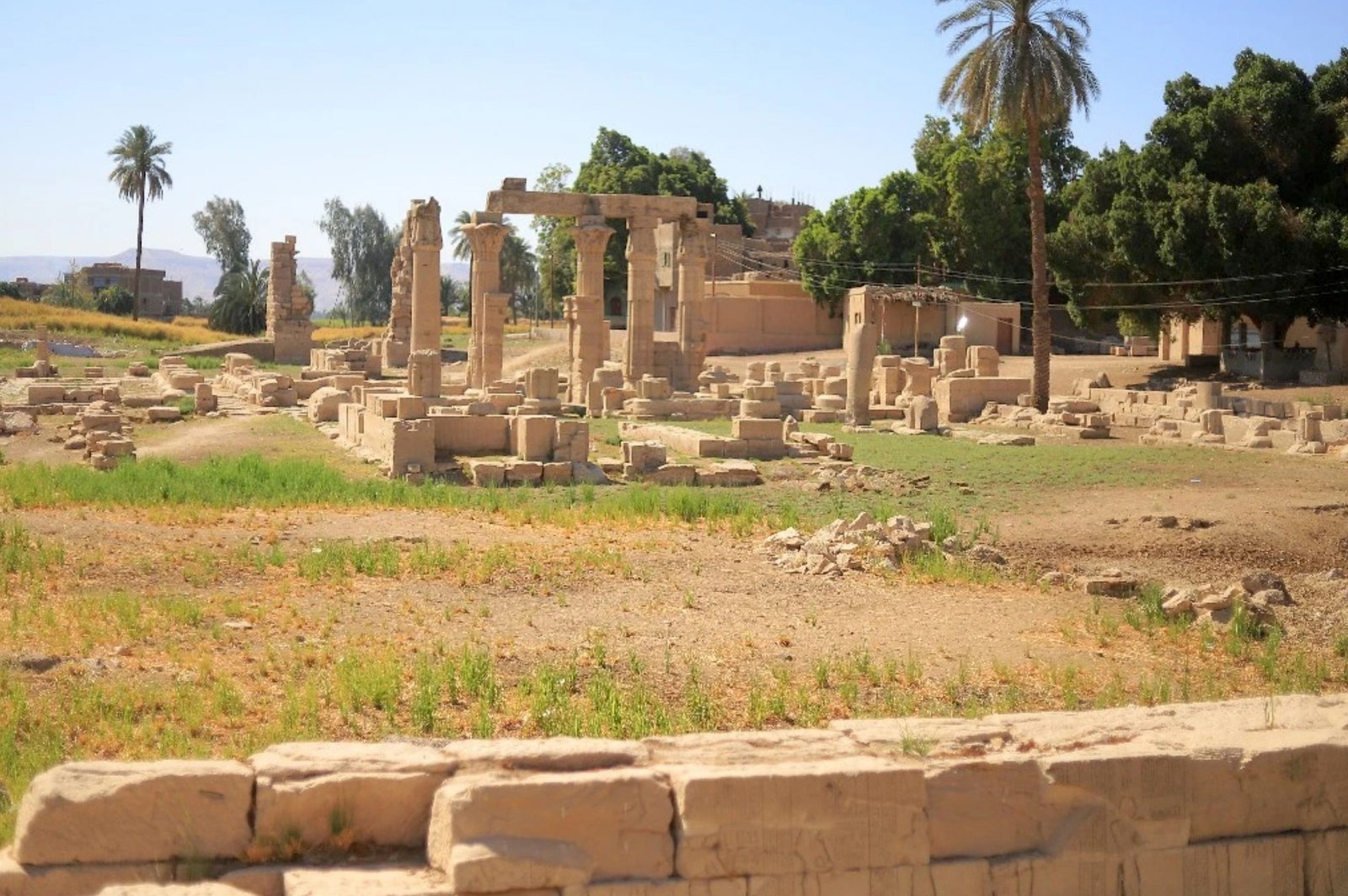
“Madu”… the original name of the region
The original name of the region is “Madu”, and it is the capital of the Central Region (the fourth region in Upper Egypt). The temple represented the northeastern façade of ancient Thebes, and was associated with special sanctity as a center for the worship of the god “Montu” or “Monsu,” the god of war who appeared strongly in the Middle Kingdom.
The temple is also characterized by being a moving “chronological record”. Construction did not stop in one era, but rather multiple civilizations succeeded it. Its construction began in the era of the Middle Kingdom, then expanded in the New Kingdom, up to the Greco-Roman era, and there are archaeological remains dating back to the Byzantine and Coptic eras.
This architectural diversity made it more like an open temple that includes rare elements, including a lake connected to the Nile River channel, similar to those found in the Karnak Temple and the Way of Rams built by King Nectanebo of the Thirtieth Dynasty, in addition to edifices dating back to Emperor Tiberius, who reused stones from the era of King Senusret III.
The temple was part of a religious system for the worship of the god Montu, which included other centers in Armant and Al-Toud, in addition to temples inside the Karnak Temple, in what is known as the “sacred triangle” for the worship of this god. The temple also includes the audience hall and the great hypostyle hall, in addition to rooms decorated with carvings showing the god Montu in the company of King Ptolemy, in scenes that reflect the relationship between religious authority and royalty.
Antiquities outside Egypt
Note that part of the temple’s relics are currently located outside Egypt, especially in the Louvre Museum in Paris, where there are important statues and artifacts, including a statue of a ram dating back to the era of King Nectanebo I.
The site has been witnessing ongoing excavations and restoration work carried out by a French mission for years. The temple will be transformed into an open museum that requires displaying the engraved stone blocks on terraces, making it easier for visitors to see the details of the inscriptions.
The temple is also surrounded by a wall dating back to the Roman era, which was built during the reign of Emperor Trajan, and on it appears an engraving of the sacred calf Apis, which represents an evolution of some of the characteristics of the god of war, Montu.
The Temple of Al-Madamud represents a living record that shows how the ancient Egyptian expressed the concepts of power and protection through deities, and how they linked religion to daily life and politics simultaneously.
What is the area of the Temple of Montu?
The 14 acres in which the temple is located still hold secrets that have not yet been discovered. The visible area of columns and stones represents only a small part of the actual extent of the site, which extends north and south, where previous probes revealed pottery layers dating back to different eras.
The Temple of Madamud is considered one of the important Egyptian archaeological sites, even if only ruins remain of it, as the ancient Egyptians did not build their temples in vain. Rather, each temple had a religious and historical significance, behind which stood secrets and stories that were not fully told.
Nile Cruise Company – Investigations Department believes that rediscovering these stories, transforming them into attractive narratives, and presenting them differently can transform the site into an excellent tourist attraction, especially during Nile Cruise in Egypt.
Nile Cruisen Investigations Department