 Nile Cruisen Team
 The Minister of Tourism and Antiquities of Egypt opened the tombs of Amenhotep called “Rabuya” (TT416) and his son “Samut” (TT417), in the Al-Khokha area on the west bank of Luxor, after completing restoration work and raising the efficiency of the public site surrounding them, in preparation for opening them to visiting traffic.
The work was not limited to archaeological restoration only, but also included developing the services provided to visitors, including informational signs and umbrellas to protect visitors from the sun, and preparing a scientific booklet in Arabic and English, ensuring the provision of an integrated tourism experience that combines the antiquity of antiquities and the quality of services.

It is noteworthy that the restoration work included removing the rubble and uncovering important archaeological finds, strengthening the ceilings and walls, carefully restoring the inscriptions and scenes, carefully cleaning the original colors, installing modern lighting systems, and developing the security and surveillance system.
The latest technique used internationally were used to preserve the remaining relics, which provide Egyptologists with the most important information about the lives of senior officials in ancient Egypt.
Note that the two tombs were discovered during excavations carried out by the American Research Center in Egypt in March 2015, during the search for the entrance to the Djehuti cemetery (TT110).
The two burial houses were covered with rubble and suffered significant damage. They were also used for mass burials during later periods until the Byzantine era.
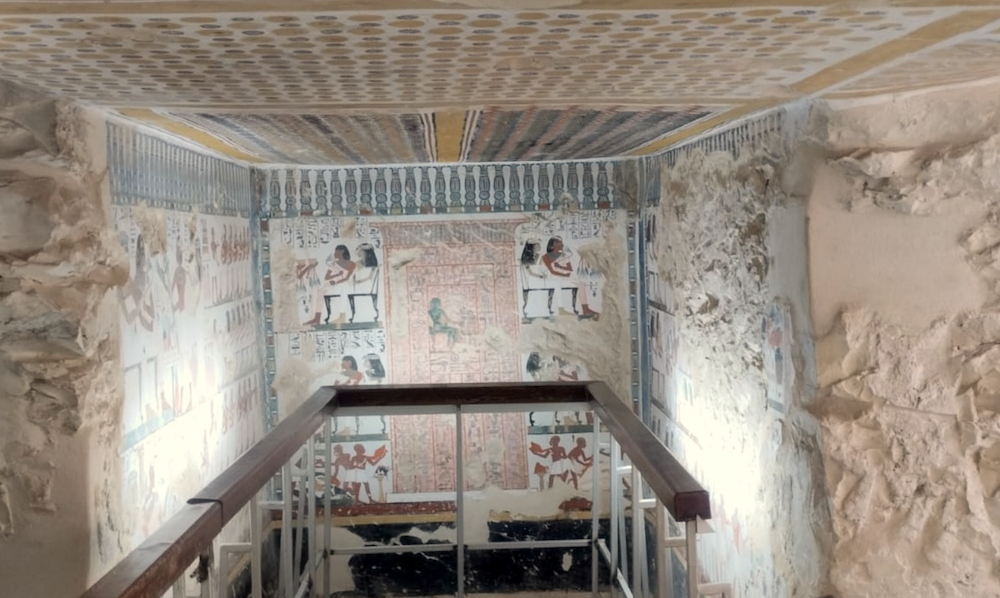
It is worth noting that the two tombs date back to the era of the New Kingdom, as the “Raboya” tomb dates back to the era of King Thutmose III, while the “Samut” tomb dates back to the era of King Thutmose IV, and they follow the T-shaped architectural style, which is the common style for the tombs of nobles in the Eighteenth Dynasty.
The two tombs include a distinct group of scenes that reflect daily life (agriculture, harvesting, industries), bread, pottery and wine making, fishing and bird hunting, in addition to scenes of banquets and celebrations inside the transverse hall.
The longitudinal hall also contains funerary scenes of the owner of the tomb, including pulling the coffin on a sled, transporting the funerary furniture to the tomb in the presence of Osiris and Hathor, and scenes of the “opening the mouth” ritual, as well as a unique view of the goddess Rennutt breastfeeding a royal child, in addition to scenes of the false door and honoring the ancestors.
It should be noted that excavation work resumed in September 2020 during the Corona pandemic, and continued until the 2021 excavation season, and included removing rubble, digging wells, and initial restoration work.
The two sites are now ready to welcome tourists during their visit to Luxor, especially Nile Cruise in Egypt, which is considered the most important stop for visitors from all over the world.