
 Nile Cruisen Team
 By: Mustafa Ali
Archaeologists Find Ramses II Statue in Sharqia
As part of the work of the Egyptian archaeological mission affiliated with the Supreme Council of Antiquities at the Pharaoh’s Hill site in Al-Husseiniyah Center in Sharkia Governorate, a huge statue was uncovered, missing the lower part that included the legs and base. It likely depicts King Ramesses II.
The Secretary-General of the Supreme Council of Antiquities confirmed that this discovery is among the important archaeological evidence that sheds light on the manifestations of religious and royal activity in the eastern Delta region. It also contributes to enhancing understanding of the phenomenon of transferring and repurposing royal statues during the era of the New Kingdom, especially in the context of the connection of regional sites with major royal centers.
The mission explained that the discovered statue is distinguished by its remarkable size, as its weight is estimated to be between 5 and 6 tons, and its length is about 2.20 meters. It is in a relatively poor state of preservation, while the remaining parts show artistic and royal features that suggest that it was part of a group (Triad), similar to what was discovered in some archaeological sites in Sharkia Governorate.
The Secret Journey of Ramses II: New Discoveries at Pharaoh’s Hill
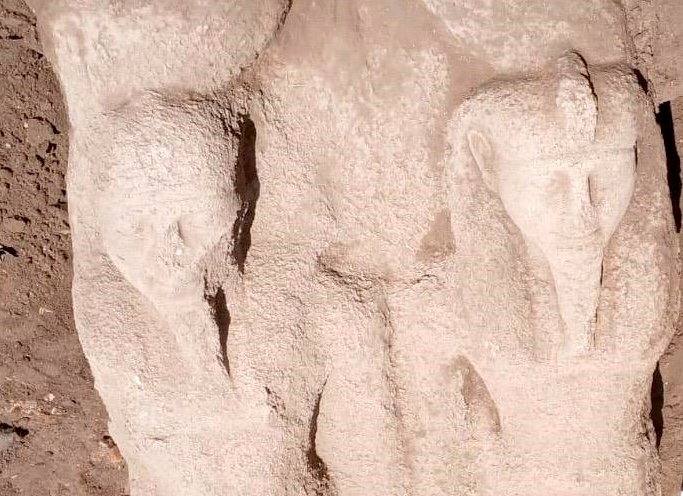
The head of the Egyptian Antiquities Sector at the Supreme Council of Antiquities said that preliminary studies indicate that the statue was moved in ancient times from the city of Per-Ramses to the site of Pharaoh’s Hill, known in ancient times as “Emet”, for reuse within one of the religious complexes, which reflects the religious and historical importance of the site throughout the ages.
As part of preserving this discovery, the statue was transferred immediately after it was found from within the temple complex at the site to the museum storeroom in the San Al-Hajar area, in preparation for the start of careful and urgent restoration work, in accordance with the highest scientific standards followed in the maintenance and preservation of antiquities.
It is worth noting that last September, a stone plaque was unveiled representing a new version of the famous Canopus Decree, which was issued by King Ptolemy III in 238 BC. When the high priests gathered in the city of Canopus (east of Alexandria) to sanctify and venerate King Ptolemy III, his wife Berenice, and his daughter, and to distribute the text of the decree to the major Egyptian temples.