 Nile Cruisen Team
 by: Mustafa Ali
The Supreme Council of Antiquities is implementing many archaeological projects to preserve Egypt’s cultural heritage and to open new attractions for visitors, both citizens and tourists, in a way that contributes to improving the tourist experience at the Egyptian destination. Three archaeological tombs are being restored and developed in the Al-Khokha cemetery on the West bank of Luxor, in preparation for opening two of them to visitors during the coming period, while the third tomb is already open for visiting after its development.
The project includes the tomb of Amenhotep, called Raboya (the father) No. (TT416), guard of the Gate of Amun at Karnak, which dates back to the era of King Thutmose III, and the tomb of Samut (the son) No. (TT417), which dates back to the era of King Thutmose IV, in addition to the tomb of Nakht No. (TT52), which also dates back to the era of Thutmose IV, and which is currently open to visitors.
In this context, The Minister of Tourism and Antiquities in Egypt, said that the restoration project for these tombs comes within the framework of the ministry’s strategy to preserve the ancient Egyptian heritage and make it available to visitors in a manner befitting its historical value, indicating that the restoration work is not limited to preserving archaeological elements only, but extends to include improving the visitor’s experience through developing services and infrastructure, thus enhancing Egypt’s position as a global tourist destination for cultural tourism.
For his part, The Secretary-General of the Supreme Council of Antiquities – Egypt, explained that the restoration work was carried out according to the latest scientific methods, and with the participation of specialized teams of restorers, stressing that the project aims to achieve a balance between preserving the authenticity of the tombs and protecting them from factors of damage, and making them available for visiting in a safe and orderly manner.
He pointed out that the three tombs represent distinct examples of the art and depiction of daily life and funerary beliefs during the New Kingdom era, and are important additions to the map of tourist visits on the western mainland in Luxor.
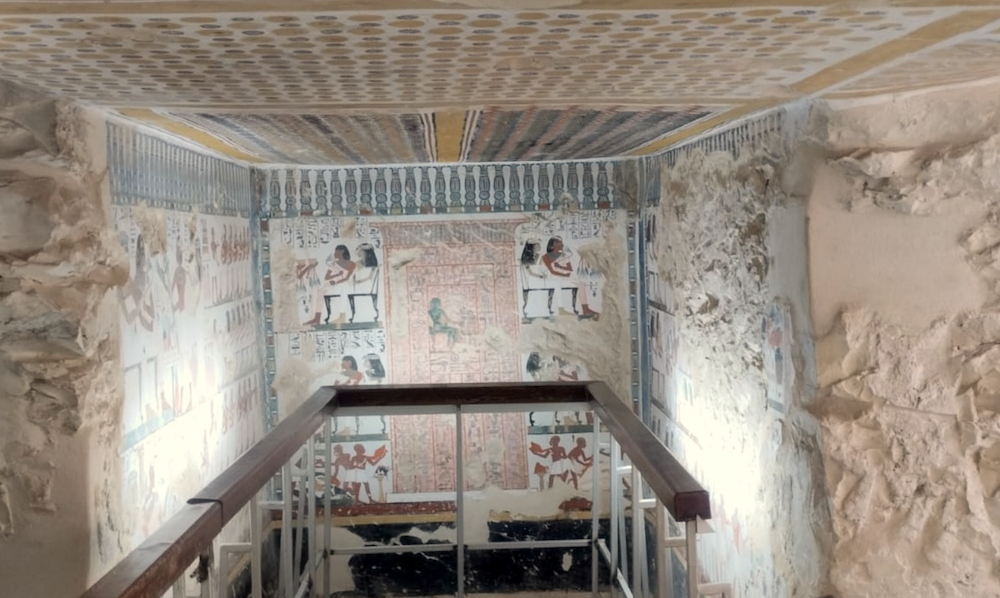
Moamen Othman, Head of the Restoration and Antiquities Projects Sector at the Supreme Council of Antiquities, answered how the restoration worked to protect the anceint Egypt tombs? explained that the restoration work of the two tombs (TT416 and TT417), which are scheduled to be opened for the first time since their discovery in 2015, included the implementation of an integrated program that included the careful restoration of the wall scenes, the architectural restoration work of the walls, in addition to the removal of rubble, mechanical cleaning, treatment of cracks, and strengthening and maintaining colors.
The works also included developing the infrastructure for the visit, by constructing wooden floors, installing a modern lighting system, paving the outer courtyard, and constructing stone stairs to facilitate the movement of visitors, in addition to providing the area with informational signs, wooden umbrellas and seats for the comfort of visitors, as well as preparing an informational material and a guide booklet in Arabic and English.
For his part, The head of the Egyptian Antiquities Sector at the Supreme Council of Antiquities, pointed out that the two tombs are distinguished by their architectural layout in the shape of the letter (T), which is the prevailing style in the tombs of the Eighteenth Dynasty, as each of them includes a transverse hall decorated with scenes of daily life, and a longitudinal hall that includes funerary scenes. The two tombs were also reused during the Late Period, adding new architectural elements, such as chambers and funerary wells.
He added that the “Rabuya” tomb is full of agricultural scenes and distinctive funerary rituals, including a rare scene of offering sacrifices to the goddess Rennott, while the Samut cemetery, although incomplete, contains high-quality artistic decorations.
As for the tomb of Nakht, the scribe of the storehouses from the reign of King Tuthmosis IV, which is open to visit, the development work included replacing and renewing the system for protecting the scenes and wall inscriptions. The old glass that had surrounded it since the 1990s was replaced with modern glass that ensures the preservation of the inscriptions while improving internal ventilation, in addition to modernizing the lighting system and carrying out careful restoration work on the inscriptions. The restoration team also carried out comprehensive cleaning work for the tomb, which included removing dust, mechanical cleaning, and treating fine cracks.
In its general layout, the tomb follows the prevailing architectural style of the 18th Dynasty tombs, as it includes an entrance leading to a transverse hall and then a longitudinal hall with a statue gap in the middle. The inscriptions on its walls depict Nakht and his wife offering aromatic oils to the sacrifices, in addition to scenes of him supervising agricultural work, as well as various scenes of presenting various sacrifices.