 Nile Cruisen Team
The team of archaeologists at the Karnak temple has discovered a sacred lake, offering rare insights about the religious rituals of the ancient times. In Luxor’s Karnak temple complex, the newly discovered “sacred lake” is believed to have played a major role in ceremonial rituals.
It is also one of the first sacred lakes from ancient times that has gone under systematic excavation, which results in offering a lot of new data to the scholars about religious practices.

Eight Years for a Rare Discovery
The mission is led in a collaboration of an Egyptian-Chinese archaeological team between the Chinese Academy of Social Sciences and the Ministry of Tourism and Antiquities in Egypt for eight years. After continuous effort and a systematic excavation process, the team has unearthed the sacred lake within the temple precinct of Montu at the Karnak complex in Luxor.
The man-made reservoir was around 50 square meters; it’s not just about the remarkable design, but the design also offers huge evidence of the ancient craftsmanship and archaeological knowledge. The officials are stating it as a turning point for the understanding of religious practices in Egypt.
Chinese official and head of the mission, Jia Xiaobing, has said that “this is the sacred lake in Egyptian archaeology, which has undergone a systematic excavation, providing a wealth of information for research and studies of sacred lakes.” This statement by the senior officer depicts the rarity of the discovery. Mostly the sacred lakes are left wrapped in mystery and unexplored; even now few lakes have been studied. This systematic excavation has allowed the archaeologists and historians to study how these sacred lakes were used for ceremonies and religious practices.
A senior inspector of the Montu temple, Hend Aly, who is the Egyptian member of the mission, has also stated the significance of the find. While sharing his views, he shed light on the hard work of eight years on the joint missions and recalled an incident when the team began the work with a “large dump of sand and dust.” The endless efforts and planning finally have borne fruit after the eight years, as the team found the big sacred lake. The discovery has also opened the door for archaeologists and researchers to find more interesting revelations in the future in the surroundings of the Karnak temple complex.
Discoveries at the Montu Temple, Karnak temple complex in Luxor
Other than the discovery of the prominent sacred lake, teams have also found a list of artifacts in the excavation that speaks about the lives of priests and religious practices followed thousands of years ago in ancient Egypt.
In the findings, archaeologists get the remains of the cow jaw and some reused stone block closely associated with the divine adoratrice (a term used for the highest role of the priest who performs rituals for the deity in Egypt’s late period). With that, the evidence also depicts the role of royal women as chief attendants of the god Amun, overall the discovery is offering valuable insights about the religious and political dynamics of that period from ancient Egypt.
With that, the teams making discoveries also explored the surrounding parts of the Montu temple. It includes the Osirian chapel area, and here they have found the three chapels dedicated to the prominent deity Osiris, with dozens of statuettes and fragments related to the divine adoratrice. All these discoveries speak about the religious practices of the 25th and 26th Dynasties, which is helping to understand ancient Thebes and provides the rich historical context to the sacred lake.
Importance of Sacred Lakes in Ancient Egypt
Egyptian temples and sacred lakes have a close connection; the water reservoirs are used for purification rituals of the deities and offerings. In the ancient religious context these water bodies are seen as a symbol of purity and divine sustenance, so the lake discovered at the Montu temple is also believed to have been used for ceremonial purposes. These water bodies near the temples are completely separated from the water reservoir used for regular purposes; it is a sign of divine presence.
The newly found sacred lake also added a layer of deep understanding about the religious practices being carried out in ancient times. It is showing that water was an important feature in spiritual and architectural design. With the discovery of the lake, it is now opening new fields to study and explore for archaeologists and historians during future missions.
Conclusion
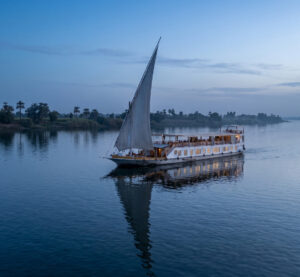
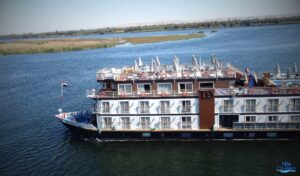
This new excavation, which is carried out in systematic ways, has marked a new beginning for archaeology in Egypt at the Karnak temple complex. It is the world’s largest open-air museum that the tourists usually explore on the Nile cruise trips, and now it is offering advanced archaeological insights. So, during your tour in Egypt, if you need any assistance for booking a Nile cruise, contact us and follow us to know the travel updates about Egypt.